

Full-Form CVD Reinforcement for Precision Plunge Dressing
Extending the life of a diamond rotary dresser starts with protecting the areas that wear out fastest. For one aerospace supplier producing turbine blades, heavy wear in a critical section of its plunge dresser meant it was time to look for a more durable solution.
Continental Diamond Tool approached the challenge by incorporating chemical vapour deposition (CVD) diamond directly into the dresser’s complex working profile. The design brings together precision reverse plating, multi-piece construction, and targeted reinforcement to help reduce replacement costs and extend tool life by up to 50%.
Watch the video or read the article below to learn more.
Solving Premature Dresser Wear in Aerospace Production
A major aerospace component supplier came to CDT after a competitor’s diamond roll was wearing out prematurely. The tool dressed grinding wheels used to produce turbine blade serrations in high-volume production.
The customer uses VIPER grinding on a Makino platform to produce these complex aerospace forms. In this kind of application, even minor dresser wear can change the grinding-wheel profile and ultimately affect the finished blade.
CDT engineers developed a solution using:
A precise plunge-dressing form
Reverse-plated diamond construction
Multi-piece design
Full-form CVD reinforcement
Together, these features address the central challenge: to reproduce the required form accurately and consistently while helping the customer manage wear without unnecessary tooling expense.
What Makes a Plunge Dresser Different?
The difference between traverse and plunge dressing comes down to how the dresser creates the grinding wheel profile.
A traverse dresser moves across the grinding wheel along a programmed path to generate the required profile. A plunge dresser carries that shape on its working surface and transfers it directly into the wheel with a plunging motion.
For manufacturers producing the same complex form repeatedly, plunge dressing offers a practical advantage, but only if the dresser maintains its profile. In high-volume aerospace production, even a slight change in the dresser’s shape can carry through to numerous finished parts. For our customer producing turbine blades, extending tool life was essential to preserving serration accuracy over more dressing cycles.
Why Reverse Plating?
Tight-tolerance turbine blade profiles leave little room for variation. Reverse-plated diamond rolls are manufactured using precision moulds and controlled electroplating to achieve a highly accurate final working form.
Sintered assemblies tend to be more robust and have a faster turnaround. On the other hand, reverse plating is particularly well suited to applications where accurately reproducing an intricate profile is a priority — and it can be more cost-effective to produce — but it generally has a longer manufacturing time.
CDT’s North Wales operation has specialized in diamond rotary dressers since 1984. That's more than 40 years making reverse-plated dressers for precision applications. This experience gives our engineers a strong starting point when a tool wears sooner than it should. They understand how design changes affect profile accuracy, durability, manufacturability, and cost, and how to balance those demands.
Multi-Piece Construction Controls Replacement Cost
The customer’s existing diamond roll already had a useful feature: two separate sections that could be replaced independently.
This approach is useful when one area of a complex profile wears faster than another. The customer can replace the worn section and keep the rest of the assembly in use, helping make replacement more economical.
CDT has used this approach in other “fir tree” turbine blade applications where wear is concentrated in a specific area. For this customer, the multi-piece design already helped manage the cost of uneven wear. Our team's challenge was to help the section doing the hardest work last longer.
Full-Form CVD Reinforcement Adds Durability
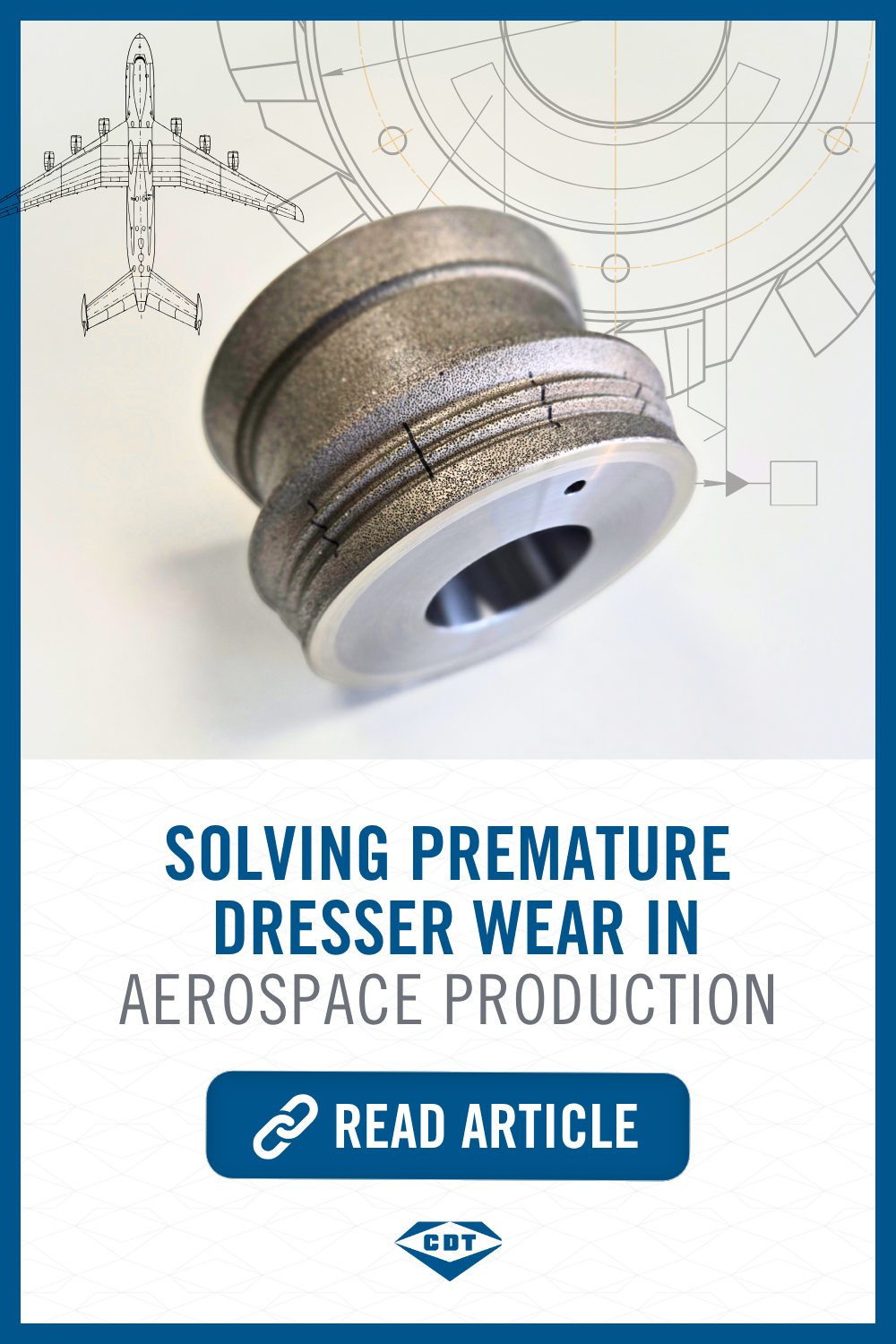
CDT incorporated full-form CVD diamond reinforcement directly into the dresser’s serration section. The reinforcement follows the critical plunge-form profile, helping protect the precise shape transferred to the grinding wheel.
The CVD reinforcement is designed to improve wear resistance, maintain profile accuracy through more dressing cycles, and extend the usable life of the section with higher wear .
While a multi-piece design makes replacement more practical, CVD reinforcement aims to make it less frequent. In this application, CDT expects the CVD-reinforced design to improve roll life by as much as 50%.
Longer usable life can help reduce:
Tool replacement costs
Production interruptions
Wear-related scrap
The investment also needs to make sense financially. CVD reinforcement adds cost, so where it goes matters. By concentrating it in the section experiencing the most severe wear, CDT targets additional durability where it can deliver the greatest value.
Custom Dressing Solutions for Aerospace
When a diamond rotary dresser wears prematurely, understanding where and how it wears is the starting point. From there, we can draw on manufacturing and application experience to engineer a custom construction and apply advanced materials where they can help.
CDT’s aerospace grinding and dressing products support applications ranging from turbine blades and vanes to gears, bearing components, and landing gear parts. These components demand precise, repeatable grinding wheel profiles and tooling that holds up through many production cycles. Our experience also extends to automotive, power generation, medical, and other high-precision industries, helping customers maintain accuracy, extend tool life, and control tooling costs.
Every grinding operation brings its own requirements. Profile geometry, grinding wheel specifications, machine configuration, tolerances, surface finish, and wear patterns all influence the final design.
If a wear-prone section is shortening the service life of your plunge dresser, bring the challenge to CDT. Our team can evaluate whether full-form CVD reinforcement or another custom dressing solution could help you maintain accuracy and get more value from your tooling.
-
Full-form CVD reinforcement incorporates engineered diamond material directly into a defined section of the dresser’s working profile. In a plunge dresser, the CVD follows the profile of the tool to add wear resistance and help preserve the form transferred to the grinding wheel.
-
CVD may be worth considering when one critical area wears out before the rest of the diamond rotary dresser, causing issues with profile accuracy. CDT reviews the geometry, wear pattern, and grinding conditions to determine whether reinforcement is a good fit.
-
Multi-piece construction lets you replace a worn section while keeping the serviceable section in use. CVD reinforcement is intended to help that higher-wear section last longer, extending the time before replacement is needed.
-
Potentially. If the dresser produces more acceptable parts before replacement, its tooling cost is spread across more parts. Fewer replacements and better profile retention may also help reduce interruptions and wear-related scrap. Those benefits need to be weighed against the added cost of reinforcement.
-
A dresser drawing, photographs or the worn tool itself, and current tool-life information are useful starting points to evaluate premature wear. Grinding wheel specifications, dressing parameters, and the tolerance limits that trigger replacement help our engineers understand what the tool needs to do and where it is falling short.
