

Micro tools require incredible accuracy and extreme process control. Continental Diamond Tool specializes in superabrasive grinding wheels and dressing tools that support such high-precision, high-stakes applications in industries such as medical, aerospace, electronics, and more. In a demonstration at United Grinding North America, CDT Application Engineer Harrison Sheldon explains how our resin bond wheels for the cutting tool industry are built to handle the tight tolerances and heat challenges of micro-grinding.
Watch the video or read the article below to learn more.
How CDT Tackles Micro-Tool Precision
As workpieces get smaller, the margin for error becomes razor thin. With micro-grinding, the challenge is to consistently hit tight tolerances while holding edge detail and controlling heat build up. All three have to be managed at the same time to get consistent results.
Continental Diamond Tool (CDT) develops custom superabrasive grinding wheels specifically for these conditions. Our engineers help manufacturers achieve reliable, efficient grinding, even at extremely small scales.
What Makes Micro-Grinding So Challenging?
With micro-tool grinding, there is a lot happening in an extremely confined space. Conditions differ from typical grinding when you are:
Maintaining edge integrity at sub-millimeter diameters
Managing heat in a highly concentrated grinding zone
Aiming for complex tool geometry with minimal material removal
Preventing premature wear on delicate cutting features
These conditions are challenging for any grinding wheel. More than anything else, correct wheel specification is critical to hitting production goals.
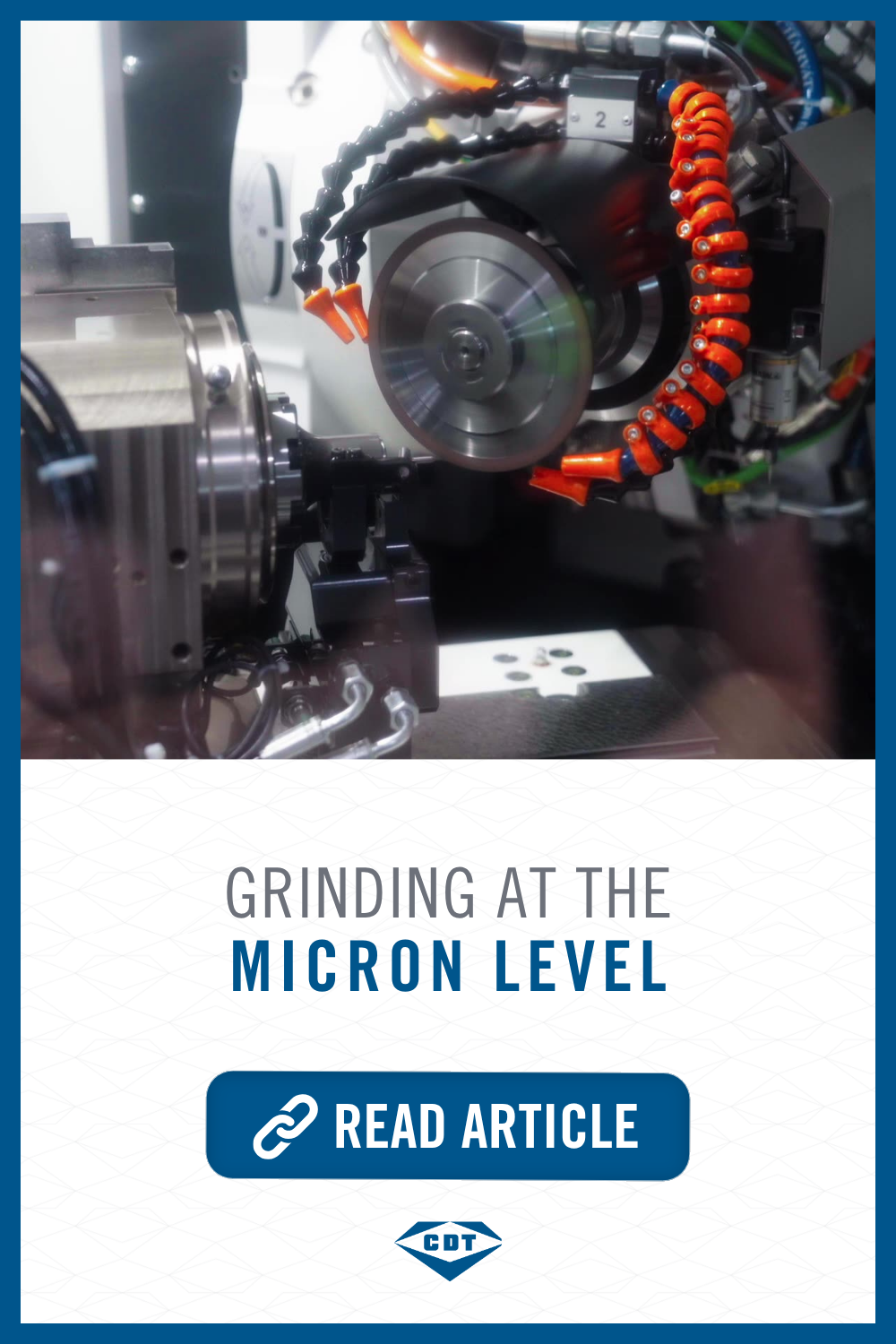
Demonstrating Copper Resin Wheels on the WALTER HELITRONIC MICRO from United Grinding
We caught up with CDT Application Engineer Harrison Sheldon at the Precision Summit at United Grinding North America in Ohio where CDT was showcasing resin bond wheels running on the WALTER HELITRONIC MICRO. This platform is designed for high-precision micro-tool production.
“Today on the MICRO, we’re demonstrating our copper resin wheels in a fine grit for grinding micro tools,” Harrison explains.
In this demo, CDT wheels are grinding a 0.016” diameter ball nose end mill — a tool roughly four to five times the thickness of a human hair. These tools are used for 3D contouring and precision finishing, creating smooth surfaces and complex shapes that flat tools can’t reach. These micro tools show up in the manufacturing process for:
Medical components like implants
Aerospace parts like turbine blades and vanes
High-precision molds and dies
Grinding a 0.016” end mill requires tight control of material removal, heat, and form. At CDT, we engineer copper resin bond wheels specifically for this purpose:
Fine-grit superabrasives (typically diamond for grinding carbide) support precise cutting at small scales
A copper core helps conduct and dissipate heat away from the grinding zone
Abrasive concentration and bond structure are custom-formulated to handle the forces in this micro environment
This wheel’s design elements support the corner retention and thermal stability Harrison calls out in the video.
Benefits of Diamond Resin Bond Grinding Wheels
At CDT, we look at the core challenges of an application like micro-grinding and engineer our wheel core, abrasive, and bond systems to directly solve them:
“A key benefit to the resin bond technology we're using today is its ability to hold corner, along with its thermal stability,” says Harrison.
Here’s how those benefits show up and pay off in real micro-grinding operations:
1. Corner Retention
Corner retention is the wheel’s ability to hold a sharp edge and maintain form over time. At CDT, our product engineers adjust factors like abrasive concentration, porosity, bond chemistry, and more to resist edge breakdown and hold profile. This enables:
Sharp geometry even on small features
Longer wheel life and less dressing
Consistent performance over longer cycles
2. Thermal Stability
The grinding process produces a lot of heat at any scale. Thermal stability is the wheel’s ability to manage heat while grinding and maintain consistent cutting behavior under load. The interaction of the wheel's fine-grit abrasive, custom resin bond, and copper core helps control temperature in our micro-grinding demonstration. In practice, this means the wheel:
Conducts and dissipates heat away from the grinding zone
Prevents burn and metallurgical damage through cooler grinding
Improves overall part quality and surface finish
3. Efficient Material Removal
Efficient material removal is about maximizing Q-prime (material removal rate) without sacrificing part quality or tool integrity. The goal is to increase removal rates while maintaining control of form, surface finish, and wheel wear. In practice, this means engineering both the wheel and process to:
Maximize material removal rates while maintaining precision
Support high-quality surface finishes
Extend wheel life under demanding conditions
Ultimately, optimizing these performance factors helps reduce cost per part.
Customizing for Micro-Tool Grinding
Conventional grinding wheels fall short in high-precision micro applications. AT CDT, we design, develop, and distribute superabrasive solutions tailored to:
Specific tool geometries
Material compatibility
Machine platforms (like the WALTER HELITRONIC MICRO)
Desired surface finish and tolerance requirements
Micro-tool grinding is a unique process that requires attention to all of these parameters to achieve the best results.
On the Edge of Grinding Innovation
As micro-tool applications continue to push the limits of precision, CDT develops solutions that deliver:
Edge quality
Tight tolerances
Cool grinding behavior
These characteristics are essential for manufacturers producing high-performance micro tools across industries such as medical, aerospace, and precision machining. If you’re running a WALTER HELITRONIC MICRO or a similar platform, visit cdtusa.net or connect with our team to discuss how CDT can help optimize your grinding process.
-
Micro-grinding is a high-precision machining process used to shape extremely small tools and components, often at sub-millimeter scales. Parts can be as small as a few human hairs. It is critical in industries like medical, aerospace, and electronics because it enables the production of complex geometries, tight tolerances, and high-quality surface finishes that standard grinding methods cannot achieve.
-
Resin bond grinding wheels are ideal for micro-tool applications because they offer excellent corner retention, flexibility, and thermal stability. These properties allow the wheel to maintain sharp edges, reduce heat buildup, and deliver consistent performance when working with delicate, small-scale tools. Performance can be enhanced with custom engineered hybrid bond varieties.
-
Heat plays a significant role in micro-grinding because excessive temperatures can cause tool damage, burn marks, and changes in material properties. Proper heat management—through wheel design, bond type, and cooling strategies—helps maintain part integrity, improve surface finish, and extend tool life.
-
Abrasive selection is critical in micro-grinding. For example, diamond abrasives are commonly used for carbide materials due to their hardness and precision. The right abrasive type, grit size, and concentration directly impact cutting efficiency, surface finish, and the ability to maintain tight tolerances.
-
Customization ensures that the grinding wheel matches the specific requirements of the application, including tool geometry, material type, machine platform, and desired finish. Tailored solutions improve accuracy, increase efficiency, reduce wear, and ultimately lower the cost per part in high-precision manufacturing processes.
