

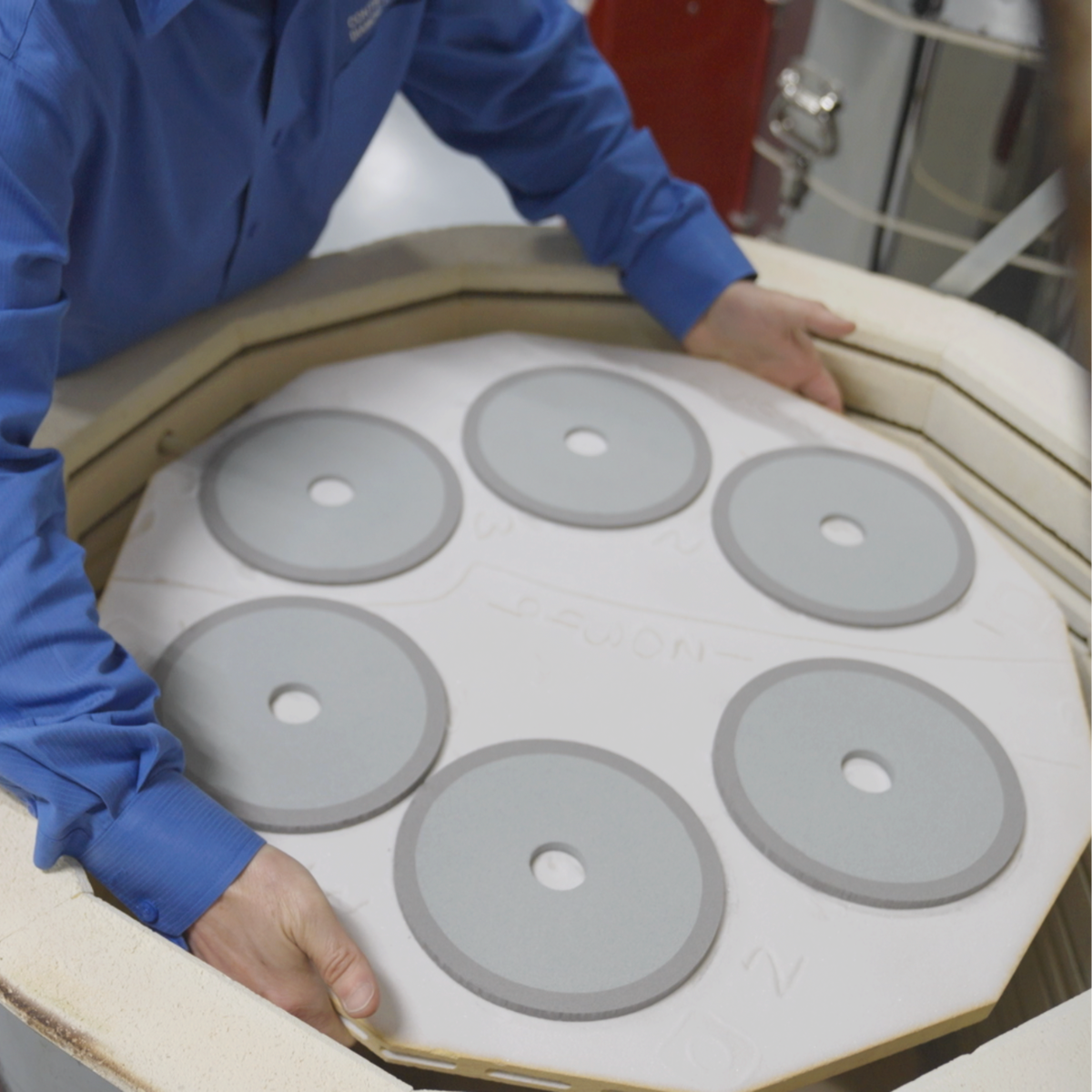
Vitrified bond grinding wheels are baked at high temperatures in a kiln during their manufacturing process.
When selecting a superabrasive grinding wheel, one important decision is whether the application calls for an electroplated wheel or a bonded wheel. While both use diamond or CBN abrasive, the manufacturing methods, performance characteristics, and ideal applications differ significantly.
At Continental Diamond Tool Limited in Wales, custom electroplated tooling is a core capability. In 2025, we expanded to 30,000 square feet of manufacturing space dedicated to electroplated grinding wheels and reverse-plated diamond rotary dressers. We also provide our customers access to bonded grinding technologies manufactured by CDT in the United States. The way each type is manufactured directly influences its strengths and ideal applications.
How Bonded Wheels Are Made
Bonded wheels are manufactured using a powder-based moulding process. Abrasive grains are blended with bond powders and fillers, placed into precision moulds, and pressed under controlled temperature and pressure. The wheel is then machined to its final dimensions.
Because bonded wheels are formed in moulds, there are practical limits to the geometries that can be produced. Profiles can be precise, but highly intricate or complex shapes are more difficult to manufacture compared to plated tools. In some designs, epoxy is used to attach the abrasive section to a separate core. In other cases, the core and abrasive layer are moulded and pressed together as a single structure.
This moulding process distributes abrasive throughout the entire grinding section, directly influencing how bonded wheels perform in operation.
Where Bonded Wheels Excel
Because the abrasive is embedded throughout the wheel structure, bonded wheels can be dressed repeatedly and engineered for characteristics that maintain form accuracy and extend usable wheel life.
Bonded diamond and CBN wheels are often:
Efficient for standard geometries and higher volumes
Lower in cost per wheel for common shapes
Well suited to sustained production grinding
TYPES of Bonded Wheels
CDT has manufactured metal bond and resin bond grinding wheels since the 1970s. These established systems remain dependable where durability and extended wheel life are required.
Hybrid bond technology builds on this foundation by combining resin and metal bond properties within the moulded structure. CDT’s EVO Hybrid Bond wheels, engineered specifically for cutting tool applications, leverage the wear resistance of metal bonds with the cutting efficiency of resin systems. In fluting operations, EVO wheels have demonstrated cycle time reductions of up to 80% compared to a competitor’s D91 wheel under controlled test conditions.
Vitrified bond grinding wheels use a ceramic (glass-based) bond system that enables precise control over wheel structure. Although vitrified bonds have existed for over a century with conventional abrasives, superabrasive versions became practical only after more recent advances in bond engineering and process control. Their porous structures allow engineers to tailor grain concentration, bond hardness, and porosity to achieve specific grinding parameters.
Benefits include:
Reduced cycle times
Improved thermal stability
Reliable performance in lights-out environments
In-process dressing with rotary dressers
Bonded wheels are commonly used in high-volume automotive and aerospace applications such as crankshaft grinding, industrial surface grinding and carbide insert grinding, where dressing and form control are integral to the process. Metal bond grinding wheels are widely used in glass shaping and ceramic grinding applications, where durability and wear resistance are critical.
How Electroplated Wheels Are Made
Electroplated grinding wheels follow an entirely different manufacturing approach.
Rather than forming abrasive blends in a mould, electroplated tools begin with a precision-machined steel or aluminum core. The exact geometry is created first through machining. Non-plated areas are masked, and the core is submerged in a nickel-based plating bath containing the superabrasive. Through an electrochemical process, a single layer of diamond or CBN is mechanically locked into place by the nickel matrix.

A plated grinding wheel is lifted from the nickel bath, where an electro-chemical process has secured a single layer of cBN abrasive to the steel core.
The result is a wheel with a single, highly exposed abrasive layer, typically encapsulated 50% depending on the application.
Because electroplated wheels are produced in both our Wales and U.S. facilities, customers benefit from responsive regional manufacturing, close technical support and access to CDT’s full plated capabilities.
Where Electroplated Wheels Excel
From our perspective in Wales, electroplated technology offers several distinct advantages.
Complex Geometries
Because the core is machined before plating, electroplated wheels can achieve intricate profiles, tight radii and application-specific forms that would be difficult or impractical to mould. This makes them well suited to specialist tooling and detailed grinding operations.
High Material Removal Rates
With a single, aggressive layer of exposed abrasive, plated wheels often deliver high stock removal rates. For applications where efficiency is critical, electroplated solutions can help reduce cycle times.
Minimal Dressing Required
Electroplated wheels require little to no dressing. This eliminates dressing downtime, simplifies set-up and can improve overall machine utilisation.
Replating Capability
When worn, plated tools can often be stripped and replated, extending usable life and improving cost efficiency over time.
Electroplated wheels are commonly used in applications requiring highly customised geometries, including broach grinding, thread grinding, and form grinding of carbide tools. They are also used in composite and ceramic applications where aggressive cutting performance and detailed profiles are required without in-process dressing.
Differences in Grinding Wheels at a Glance
| Category | Electroplated | Bonded |
|---|---|---|
| Manufacturing Method | Machined core with nickel-plated abrasive layer | Powder blend moulded and pressed into shape |
| Abrasive Structure | Single layer of abrasive to a specific depth | Abrasive layered throughout the section |
| Dressability | Minimal dressing required | Dressable to prolong life |
| Geometry Flexibility | Excellent for complex forms | More limited by mould constraints |
| Production Suitability | Low to medium production, high material removal | Medium to high production, precision grinding |

Choosing the Right Technology
Electroplated and bonded wheels are not competing technologies — they are complementary solutions suited to different grinding challenges.
Electroplated wheels are often appropriate when:
the geometry is complex or highly customised
high material removal rates are required
minimal dressing is advantageous
a specialist form is needed
Bonded wheels may be preferred when:
tight dimensional tolerances must be maintained over extended production runs
consistent surface finish is critical throughout the batch
the long-term cost efficiency of the process favours a dressable wheel
At Continental Diamond Tool Limited, we regularly support customers that use one or both options in their process. With CDT having manufacturing capabilities in plated and bonded technologies, we can recommend the most suitable solution based on application requirements.
Discuss Your Grinding Application with Our Team
While CDT in Wales specializes in electroplated manufacturing, our customers benefit from access to CDT’s complete bonded portfolio in the United States, including the latest hybrid and vitrified bond solutions.
Whether the application calls for the geometric flexibility of plated tooling or the dressable precision of bonded wheels, our engineering team is ready to help determine the right path for your application.
If you’re reviewing a current grinding process or launching a new product, contact CDT to discuss which bond technology will deliver the best performance for your operation and receive a competitive quote.
-
Electroplated grinding wheels are generally the better choice for complex geometries. Since the core is machined before the abrasive layer is applied, they can achieve intricate profiles, tight tolerances, and highly customized forms that are difficult to produce with moulded bonded wheels.
-
Electroplated wheels require minimal to no dressing, making them easier to maintain and reducing machine downtime. In contrast, bonded wheels need periodic dressing to maintain their shape and performance, but this also allows them to extend their operational life.
-
Cost-effectiveness depends on the application. Bonded wheels are often more economical for high-volume production because they can be dressed and reused over extended periods. Electroplated wheels, while not dressable, can sometimes be replated, offering value in specialized or lower-volume applications.
-
Electroplated wheels are typically better suited for low to medium production runs where high material removal rates and precise forms are required. For continuous, high-volume production with consistent output, bonded wheels are often the preferred option.
-
Yes, many manufacturers use both types within a single operation. Each wheel type serves different purposes—electroplated wheels for specialized or complex tasks, and bonded wheels for maintaining consistency and efficiency in larger production runs.
