


News and Resources
Browse by Category
Browse by Product
- All Dressing Products
- All Grinding Products
- CBN-Diamond Superabrasives
- Conventional Abrasives
- Diamond Lapping Compounds
- Diamond Rotary Dressers
- Diamond Stationary Dressers
- Hybrid Bond Grinding Tools
- Metal Bond Grinding Tools
- Plated Grinding Tools
- Resin Bond Grinding Tools
- Vitrified Bond Grinding Tools

Why Superabrasives?
Superabrasive grinding wheels last longer, grind faster, cut cleaner, leave a better finish and create a sharper edge. The real question is—Why not?
When the material you are trying to process is either too hard or too delicate for conventional abrasives, custom superabrasive grinding tools might be the best solution.
What are Superabrasives?
The term “superabrasives” refers to a class of tools used in precision grinding for many industries. Superabrasive grinding products contain natural diamond, manmade diamond, and/or CBN — some of the hardest materials that can be made. Superabrasives are also sometimes called industrial diamonds: an industrial diamond is a non-gem quality small diamond that is for abrasives, cutting, and drilling tools. Other types of superabrasives include:
Cubic boron nitride (CBN): Usually called CBN, this is the second hardest cutting tool material after a diamond.
Polycrystalline: This is an abrasive material that has multiple collections of crystal grain structures with individual orientations.
CVD Diamond: These are synthetic diamonds made by a process known as chemical vapor deposition. CVD diamonds grow from a hydrocarbon gas mixture. They are extremely hard and have a high thermal conductivity that is five times that of copper. They also have broadband optical transparency, are chemically inert, and only reach graphitization at very high temperatures.
Nano-diamonds: These tiny diamonds are the product of a controlled explosion. They are sometimes called detonation nano-diamonds (DND) or an ultra-dispersed diamonds after how they are formed.
These abrasive materials have been labeled as superabrasive due to their extraordinary hardness, unparalleled performance, and longevity. Continental Diamond Tool uses these superabrasive materials to make custom grinding wheels and products, including plated, vitrified, resin bond, metal bond, hybrid bonds, and rotary dressers, for many complex applications.
Superabrasives vs. Conventional Abrasives
Superabrasives, whether natural or manmade, have a hardness range that distinguishes them as some of the most durable materials on Earth. Conventional abrasives are made with much softer abrasive materials that are less expensive but break down faster. The best abrasive product for your application depends on the material you are grinding and what properties you need to achieve your desired results.
Industries that Use Superabrasives
A great number of industries use superabrasive grinding wheels, and the custom-coated abrasives subsection of the abrasives industry continues to grow. Industries that regularly invest in superabrasive grinding wheels are:
Aerospace
Automotive
Medical
Electronics
Composites
Oil Industry
Advantages of Superabrasives
The advantages of superabrasive grinding wheels are more than extraordinary hardness, unparalleled performance, and longevity. These three features of superabrasives are the core of many advantages manufacturers gain by an aggregation of services that normal abrasives simply cannot deliver.
Benefits include:
Less expensive tooling and fixturing costs
More wheels on the spindle, smaller wheels, multiple operations
Less floor space needed for manufacturing
Virtual elimination of wheel wear
Automated CNC machines, less labor intensive operations requiring less training
Consistent surface speed from part to part
Better overall throughput with fewer machines needed
Improved material removal rates, lower per part abrasive costs, and higher speeds
With superabrasives, industries have been able to increase production with automated CNC equipment, compensating for a lack of available, skilled labor. With custom superabrasives that are optimized for their process, machine capabilities, and mechanization, there is less reliance on operator technique. A properly defined process, combined with automatic loaders, make for equipment that can even run itself in some cases with lights out manufacturing.
Industry Outlook
Future growth of the abrasives industries will primarily be in superabrasives. Currently, research and development of superabrasives are taking place in the following areas:
Custom designed “hard to grind” materials in an increasing number of industries
Creep or deep feed grinding
High-speed, high-performance grinding of hardened steel
Form grinding, sometimes with electroplating, in high precision, high-removal, and high-surface quality applications
CNC-control of line grinding machines
Continental Diamond Tool stays on the forefront of new abrasive technology developments in superabrasives with our state-of-the-art grinding lab focused on research and development of new hybrid bonds that take the efficiencies of superabrasives even further.
How to select the right superabrasive
CDT has a strong group of engineers, product managers, and technical sales people who can come out to your facility to review your equipment and processes, and the parts you’re looking to grind. Or, as Troy Giacherio, Product Manager for Rotary Dressers, suggests, “you can come into our facility and we’d be more than happy to have the conversation, review the whole development process, and then make our recommendations based on what we’ve seen and communicated.” Contact us for a free quote.
Learn more about superabrasive grinding solutions in this video:

How to Order Custom Grinding Wheels
Check out this guide on how to order custom grinding wheels that are a perfect fit for your operations.
Professionals in certain manufacturing industries use grinding wheels as a normal part of their abrasive cutting, grinding, and machining processes. There are numerous types of grinding wheels, as well as assorted types of abrasive materials and grains. Having and using the right tool for the job is essential, especially for precision manufacturing. It is important to determine what you need before you place an order or get a quote.
TYPES OF GRINDING WHEELS
These are only a few examples of numerous types of grinding wheels and their uses:
Centerless and feed wheels for creating extremely close tolerances on metal cylindrical parts, such as those for aircraft, automotive, and tool manufacturing
Cylindrical wheels for angular, plunge, and reverse grinding
Diamond and hybrid wheels for grinding extremely hard materials, such as carbide tips or concrete
Dish cup wheels for cutter and jig grinding
Mounted point wheels for deburring and profiling work on hard materials
Straight wheels, most commonly used for centerless, cylindrical, and surface grinding on bench and pedestal grinders
Tapered wheels for grinding gear teeth and threaded applications
TYPES OF ABRASIVES
Depending on the job you need to do and the type of grinding wheel you use, the type of abrasive you need varies. Examples of abrasives include:
Conventional: Aluminum Oxide (corundum), Ceramic, and Silicon Carbide
Superabrasive: Natural Diamond, Synthetic or Man Made Diamond, and Cubic Boron Nitride
At Continental Diamond Tool, we produce custom superabrasive grinding solutions. We can help you replace your conventional grinding wheel with the right superabrasive alternative.
ORDER GRINDING WHEELS
While some companies have local suppliers for their grinding wheels and abrasives, it's often more convenient to request a quote online, especially when you are looking to order custom grinding solutions. Here are the steps to take to order a custom grinding wheel:
Step 1
Determine the abrasive specifications required for the job. The proper grinding wheel is dependent on many factors including the grinder, coolant, material being ground, wheel dressing method, and more. To give you the best engineered solution for your grinding application, your supplier will need certain information to ensure you get the results you are looking for. Details you'll want to gather include:
Type of material: carbide, ceramics, concrete or stone, glass, or metal.
Type of grinder: manual or CNC
Type of grinding application: OD, ID, Cylindrical, Surface, Rotary Surface, Angle Head, Double Disc, Plunge, Traverse, etc.
Wheel diameter: varying from 0.008” to 40”
Thickness range: varying from 0.030” to 12”
Arbor hole size: varying from 0.040” to 20 inches
Desired finish: extra fine, fine, medium, or coarse (for minimal to heavy removal).
Coolant type
Dressing method & tools
Stock removal: If you know your selected abrasive material and required grit (varying from 20 to 8000 mesh), note that too.
Step 2
Call or use the online contact order form for your online supplier. For a custom grinding wheel, provide lots of detail about the type of tool you are using, along with its description, dimensions, and intended use. Continental Diamond Tool has a quote request form that walks you through the information we need to provide an accurate quote, and you can upload reference files if needed. Or you can always call us if you want to talk through the parameters of your project.
Step 3
At Continental Diamond Tool, we specialize in custom superabrasive grinding wheels and tools. Our team of engineers will work with you on a custom solution to your grinding needs. Depending on the nature of your project, we can run remote simulations or in-person trials and test prototypes before manufacturing the final piece. The whole process typically takes a number of weeks, but can be fast tracked if needed. At the end, our engineers will work with your team to guarantee that the grinding wheel is properly installed and performing as expected. They can also offer instruction on how to maintain your grinding wheel for ongoing high performance.
Stop getting by with a grinding wheel that isn’t optimized for the job. It's best to consult an expert to make sure your tool is a good fit for your process. In many cases, custom grinding wheels quickly pay for themselves with increased efficiency and extended tool life, and you'll see the difference to your company’s bottom line. It starts with calling 800-443-6629 or requesting a free quote online today:
Superabrasive Manufacturing: The Industries We Serve
Here’s a rundown of industries that are known to benefit from the toughness and precision of custom CBN and diamond grinding solutions through CDT. Check it out >
For industries that need to shape some of the world’s hardest substances like tungsten carbide, ceramics, and superalloys, only an extremely tough tool can do the job. Applications like these require grinding wheels and tools made with the most durable materials for cutting: natural or man-made diamond and cubic boron nitride (CBN).
Ironically, delicate substances like silicone also require the special characteristics that only these superabrasive materials can provide. With a wide variety of forms, grades, and bonds, CDT is proud to supply high-precision custom superabrasive grinding and finishing solutions for a variety of commercial, industrial, and military applications.
Here’s a rundown of industries that are known to benefit from the toughness and precision of custom CBN and diamond grinding solutions:
AEROSPACE & MILITARY
Top aircraft turbine manufacturers in the United States and around the world require precision plated form wheels and form mandrels in the manufacturing of turbine blades and other various engine parts. CBN grinding technology can be used for both the manufacturing of aircraft engine components and land-based turbine engine components. Efficient manufacturing needs shorter production runs and longer cycle times. Plated CBN wheels are the preferred choice for high precision form grinding applications of this nature.
CDT engineers are experienced with the demands of military and commercial aerospace applications, particularly in regard to turbine engine tooling and grinding solutions. We've even manufactured tooling for interplanetary use. As a leader in the manufacturing of diamond grinding tools for both air frame and aerostructure components, CDT is well-equipped to tackle this industry’s most challenging manufacturing needs.
For aerospace and military applications, superabrasive solutions are useful in working with:
Composites
Composite Material
Honeycomb Composites
Graphite & Kevlar
Reinforced Plastics
Titanium
AUTOMOTIVE
Over the years, CDT has proven to be a reliable partner to the automotive industry as a supplier of grinding tools for machining engine, chassis, and transmission components. We provide the continuous innovation, wide range of superabrasive capabilities, high quality standards, and delivery reliability that the automotive industry needs to stay competitive in an ever changing world.
The automotive industry uses superabrasive grinding products in the manufacture of many components such as:
Engines
Brakes
Steering, Suspension Systems
Parts
Rubber, Tires
Windshield Glass, Mirrors
Body Parts
CERAMICS
With extreme hardness that in some cases surpasses that of metals, the properties of ceramics offer unique opportunities and challenges for grinding in this industry. From circuit board parts, kitchenware, solar panels, pipes, and tubes to advanced technical ceramics and refractories, the ceramics industry manufactures a vast range of products that require the special characteristics of superabrasive wheels and tools. With our reputation for high precision diamond grinding wheels that work longer, cut faster, and are more durable, leaders in the ceramics industry regularly turn to CDT engineers to help them achieve their most demanding grinding and finishing requirements.
The ceramics industry uses superabrasive tools for the grinding and finishing of:
Glass
Brick, Refactories
Ceramics
Carbon, Graphite
Lavatory
Alumina
COMPOSITES, FIBERGLASS & PLASTICS
CDT has an electroplated process that is specially formulated for composites and provides outstanding cutting speed and efficiency. Our engineering team specializes in helping our customers create successful, cost effective solutions for their manufacturing needs. This applies to all types of composites, from FRP to fiberglass to Kevlar® aramid fiber. CDT's electroplated wheels have seen great success in all areas where composites are used, including: automotive, aerospace, sporting equipment (golf clubs, archery, bicycles, etc), wind energy, and military applications.
Many industries turn to superabrasive solutions when manufacturing requires these composite and fiber-reinforced plastic materials:
FRP Corrosive Resistant Material
Marine Fiberglass
Cultured Marble Types
Thermoset Resin Materials
Fiberglass Reinforced Plastics (FRP)
Composites
CUTTING TOOLS
For those companies involved in the manufacturing or resharpening of cutting tools, superabrasives have the strength and durability that such metal manipulation requires. Superabrasive tools that are custom designed to the required specs can reduce the cost per part, meet high-precision quality standards, and provide superior value.
Our engineering department has much experience achieving tighter tolerances and better performance, even with this industry’s extremely tough materials. A well designed custom grinding wheel can take a company to the next level, increasing efficiency while saving resources and time.
For the cutting tools industry, superabrasive tools are superior at grinding and finishing metals such as:
Carbide
High Speed Steel
FOOD PROCESSING, PAPER & CARDBOARD
Manufacturers of cutlery and hand tools turn to CDT superabrasives for many grinding applications. Cool cutting, fast stock removal, excellent finish, superior wheel life, and an attractive return-on-investment are prerequisites for success in the demanding grinding required in food processing and paper/cardboard.
Industries involving food processing, paper, and cardboard use superabrasive grinding products in applications such as:
Blade & Knife Sharpening
GEM
Precious Stone
Semi-Precious Stone
Corrugated & Flat Cutters
GEARS
CDT is a partner to the gear industry. Our areas of expertise include grinding wheels for virtually every operation needed in the production of gears and gear components. More broadly, our custom engineering department helps companies develop products that will maintain and improve production efficiencies on a continuous basis for whatever the customer’s need.
The gear industry uses superabrasive tools in the manufacture of:
Gear, Thread
Gear Guide, Bed
MEDICAL/DENTAL
From bone sawing to intravascular applications, CDT is regularly commissioned to engineer high precision tools for medical use. Our engineers understand the thorough testing and quality processes associated with medical device manufacturing . Our products are designed with exacting standards to achieve the tight tolerance demanded by this industry.
Medical and dental industry uses for superabrasive tooling include:
Prosthesis
Dental Instruments
Surgical Equipment
OIL & GAS
When the oil and gas industry has a job that calls for high precision grinding of carbide and PCD drill bits, wear parts, and gage blocks for oil and gas drill manufacturing, efficiency and effectiveness are extremely important. ID grinding is an exacting process that requires unparalleled precision for reliable, repeatable results. And, this industry’s CNC OD Grinders have their own unique challenges in these most difficult center-type grinding projects.
CDT has developed superabrasive advanced bond technology perfectly suited to all these needs of the oil industry. We also custom engineer each tool for longer tool life and a high stock removal, making it the best value in the industry.
The oil and gas industry turns to superabrasive tools for:
PCD/Carbide Grinding
I.D. / O.D. Grinding
POWER GENERATION
CDT has the capability to produce thousands of precision-built superabrasive products of high quality, performance, and repeatability for virtually every conceivable manufacturing area involved in power generation. The diversity in this industry calls for Vitrified, Resin Bond, Plated, and Metal Bond Diamond and CBN products to get the job done.
For the power generation industry, superabrasive tools are most commonly used in the manufacture of:
Wind Turbine
Gas & Steam Turbine
Marine Turbine
Blades
WOOD/SAW
CDT is experienced at supplying custom superabrasive products for the lumber and wood products industry. We provide grinding solutions for OEM manufacturers, filing rooms and service shops for their processes of manufacturing and maintaining band saws, circular saws, chippers, planers, and paper knives. All in all, our grinding wheels are designed to help our customers maintain and improve production efficiencies on a continuous basis.
Industry leaders in lumber and wood products use superabrasive tools for applications such as:
Carbide Tip Saw Blades
Band Saws
Knife Sharpening
OTHER MARKETS
Continental Diamond Tool has been providing technically superior precision tooling solutions to numerous other distinct industries since 1973. Over the years, we have witnessed more and more companies realize the productivity increases possible with the use of custom superabrasive products. With more parts processed per wheel and fewer wheel changes, many see how investing in this level of quality and durability pays off.
Along with those highlighted above, below are additional industries who have turned to CDT for superabrasive grinding solutions:
ELECTRONICS
Ferrites, Magnetics
Substrate (Ceramics, Glass, IC)
Quartz Crystal
Semiconductors
Printed Circuit Boards
OPTIC & PRECISION
Lens, Prism
Measuring Instruments
STONE
Lapidary Tools
Refractory Brick
Peek Materials
Granite
TOOL & DIE
Cemented Carbide Tool & Die
Special Steel Tool
Molding Die
Bearing
Pneumatic, Hydraulic, Valve
Jig
WIRE & CABLE
Precision Die
6 Common Grinding Problems and How to Solve Them
We discuss six common grinding problems and offer solutions to help you solve some of your most challenging grinding issues. Check it out >
Most grinding problems affect one of two categories: either appearance of the workpiece or productivity and return on investment. After verifying that the grinding machine isn’t at fault, there is one likely culprit causing your grinding problems: your grinding wheel.
Poor surface finish, chatter, and burning all affect the appearance of your product. Productivity issues like short wheel life, slow or inefficient cutting, or the wheel not cutting at all are also costly problems to have.
Let’s take these one at a time to see how a fix to your grinding wheel can solve some of your most challenging grinding issues.
1) POOR SURFACE FINISH
WHY YOUR GRINDING WHEEL MAY BE AT FAULT:
In the appearance category, poor finish is a common complaint when your grinding wheel isn’t optimized. Grinding is a multi-point cutting process, but broken down to the microscopic level, it has similarities to a single point operation like turning. Viewed this way, it’s easy to see how surface finish is affected by the same factors: the more material removed by each grinding point, the bigger the individual chips and the rougher the surface.
SOLUTIONS:
Select a grinding wheel with a finer grit size
Reduce the relative speed between the wheel and workpiece
OTHER POSSIBILITIES:
If grinding wet, the coolant may not be efficiently removing chips from the workpiece or wheel interface.
It's also possible that the wheel is being dressed excessively, creating grinding points that are standing too proud of the wheel surface.
2) CHATTER
WHY YOUR GRINDING WHEEL MAY BE AT FAULT:
Recognizable by a distinct, often audible, pattern on the workpiece, chatter has many causes. Wheel-induced chatter occurs when an out-of-true grinding wheel acts as an excitation source.
SOLUTIONS:
In this case the wheel should be trued carefully.
Also check that it isn’t slipping on its mount.
OTHER POSSIBILITIES:
If the problem is tracked down to a vibration in the machine — possibly some kind of resonance — the solution is to vary the grinding speed. Try going 10% faster or slower to remove the forcing excitation.
A detailed discussion of chatter is available at the Abrasive Engineering Society website.
3) BURNING
WHY YOUR GRINDING WHEEL MAY BE AT FAULT:
Machinists use the term “burning” to describe thermal damage. It can show up as cosmetic discoloration, changes in workpiece hardness, and possibly distortion-inducing internal tensile stresses. Burning can occur if the wheel is glazed or loaded, causing more rubbing and friction. This often occurs if the machinist is trying to push the wheel through the workpiece too quickly or using a wheel that’s too durable.
SOLUTIONS:
Dress the wheel with the correct dressing tool
Reduce the feed rate or the relative velocity between wheel and workpiece.
OTHER POSSIBILITIES:
Burning is far more common when grinding dry, although can still be experienced in wet grinding if there isn't enough coolant flow to carry away the heat.
See “Burn Awareness”, originally published in Cutting Tool Engineering, December 2000, for more information.
4) WHEEL LIFE TOO SHORT
WHY YOUR GRINDING WHEEL MAY BE AT FAULT:
This costly issue can be caused by a wheel that's either too hard or too soft for the workpiece. When this is the case, the grinding wheel loads up or wears away too quickly.
SOLUTIONS:
Try a grinding wheel manufactured with a different material that is better suited for your grinding operation.
OTHER POSSIBILITIES:
Insufficient coolant
Dressing your grinding wheel too frequently
Wheel speed too low
5) WHEEL CUTTING SLOWLY
WHY YOUR GRINDING WHEEL MAY BE AT FAULT:
This productivity issue is usually caused by feeds and/or wheel speeds that are too low. If you are using the wrong type of grinding wheel, you may be forced to cut slowly to avoid burning, but ultimately that’s not efficient for your process.
SOLUTION:
The solution is to find a wheel that can grind as fast as possible without burning. A grinding wheel specialists can suggest alternatives that will increase speed for your specific operation.
6) WHEEL NOT CUTTING AT ALL
WHY YOUR GRINDING WHEEL MAY BE AT FAULT:
Most likely, this happen when the grinding wheel is glazed by truing.
SOLUTION:
The solution is to dress the wheel lightly until the grit opens up. For dressing advice, consult with a grinding specialist.
OUR BEST ADVICE
THINK LOGICALLY
Most grinding problems can be solved by tracing the fault back to basic principles. With all grinding applications, imagine your material being removed by individual cutting points. Thinking from this perspective, a solution usually emerges.
Also, use your resources. The grinding experts at CDT are happy to discuss your cutting and grinding issues and offer solutions that will set your manufacturing operations on track to success.

Does CDT Carry Stock?
A lot of customers ask if we keep stock inventory on the shelf. Check out the answer in this article >
A lot of customers ask if we keep stock inventory on the shelf.
Because our customers’ needs are diverse, there are not a lot of common tools used across industries. Therefore, it is really most beneficial to us - and our customers - to only build custom. This gives us the flexibility to deliver exactly what the customer is looking for in a timely manner.
Customers are often surprised at how quickly and affordably we can deliver custom grinding wheels. We manage our inventory, control our overhead, and keep our costs low, so we can pass those savings on to our customers.
Watch this video to learn more.
To get started with custom superabrasive grinding wheels from CDT, contact us for a free quote.

How much does a Custom Superabrasive Grinding Wheel Cost?
We look at the 'total cost' of a custom superabrasive grinding wheel from CDT, and detail the advantages superabrasives have over conventional grinding products. Check it out >
A Look at the Bigger Picture >
As a custom-made product, the cost of a superabrasive grinding wheel can vary greatly from one design and application to the next. People may shy away from custom products because they think one of two things: it’s going to cost a lot more or it’s going to take a long time to complete. While that may be partially true on the surface, that’s not the whole picture.
In this article, we’re going to take a look at some of the factors that will help you assess the “total cost” of custom grinding products, which includes both what the product is and the value it provides over time. When taking everything into account, our clients often find that the custom grinding product that appeared to be too expensive actually has a return on investment that quickly pays for itself.
Here are 4 advantages to purchasing custom superabrasive grinding wheels from Continental Diamond Tool so you can weigh their value long-term:
1) Custom Grinding Wheel means a better fit.
With the right custom grinding wheel, customers have reported upwards of a 70% improvement in efficiency from conventional wheels. Our engineers work with you to reduce cycle times, maximize removal rates, minimize maintenance requirements, decrease material damage, and improve productivity wherever possible.
During the design phase, we can run simulations from our facility or travel to yours. We frequently visit customers to learn their machinery, materials, and processes so we can design a better grinding wheel that works for what they need. Some of our product options can be incorporated into lights out production which can be an even great boost to your company’s overall efficiency.
With each tool custom designed for your unique application, you get productivity out of your grinding wheel that you’ve likely never seen before. When you factor in these benefits, ROI skyrockets.
2) Custom Grinding Wheel means quality work.
Conventional wheels off the assembly line will never match the quality of custom grinding wheels from an experienced manufacturer. Custom grinding wheel manufacturers generally do not cut corners like you see with commodity products. At CDT, we use the best quality materials because it’s in our best interest to maintain longterm relationships with customers and the superiority of our products.
Experience can also be a factor with quality. Even within the industry of custom superabrasives, inexperienced engineers can cost you in development time, troubleshooting hassles, and subpar products. At CDT, we have almost 50 years of experience in old and new grinding technologies. And we’re always updating our quality control systems with state-of-the-art precision testing equipment to make sure you are getting the most efficiency from your custom grinding wheel investment.
3) Custom Grinding Wheel means the product will last.
Superabrasive grinding wheels are made from natural diamond, manmade diamond, and CBN —some of the strongest materials known to man. Conventional abrasives are made from materials like aluminum oxide and silicon carbide — much softer materials that break down more quickly. Depending on your application, a more durable product that you don’t have to replace as often may actually be a better investment.
Additionally, we have options with some of our superabrasive products where we can recommend dressing tools and even refinishing or replating services that can make your grinding wheels last even longer.
4) Custom Grinding Wheel means a great customer experience.
You may be wondering how great service actually saves you money. First, the customer service team at Continental Diamond Tool provides free quotes, product selection and design assistance. You don’t have to research and guess what you need. A specialist will provide product recommendations and a competitive quote for you for free.
Second, a company like CDT whom you have a personal relationship with will do everything they can to help. For example, we know that waiting on a grinding wheel order can be painful for your company’s productivity and bottom line. Delays may throw off your production calendar and anger customers. That is why we’ve taken measures — like stocking an extensive inventory of raw materials — so we can deliver your order faster than others in the industry. Additionally, once your product has been developed, a reorder can be produced and shipped much faster.
Third, service doesn’t stop at the sale. While some big name custom superabrasive and conventional wheel manufacturers have cut corners in service for better bottom lines, CDT has remained true to our founding principles. Does your grinding wheel supplier train your team on installation and maintenance? Will they come to your facility to review your machinery and processes to make sure your grinding wheel is optimized for peak performance? Do they notify you when new technology becomes available that could make your processes even more efficient? At CDT, our personal sales team and tech support are here to help you overcome the obstacles to increased productivity and success.
Learn more about superabrasives and how they differ from conventional grinding wheels in this video:
To get started with custom superabrasive grinding wheels from CDT, contact us for a free quote.

How CNC Automation at Continental Diamond Tool Benefits Customers and Employee
With CDT’s recent investment in CNC automation through robotics, they are seeing benefits to quality, speed, and employee satisfaction. Check out what this new technology means for CDT customers and employees >
Continental Diamond Tool has been in business since 1973, and in that time we’ve grown to rank among the world’s top manufacturers of Diamond and CBN wheels for drilling, cutting, and grinding applications. One key component of our growth has been our investment in innovation, both with our products and our processes. With our recent investment in CNC automation through robotics, we're seeing benefits to quality, speed, and employee satisfaction. Let’s look at what this new technology means for our customers and employees.
Quality Matters
Quality has been an area where Continental Diamond Tool has invested heavily in systems and automations that allow us to test and assure the accuracy of every product that leaves our facility. Robots take this a step further, producing consistent products with minimal, if any, defects. Robots are perfect for doing repetitive jobs with precision and efficiency.
In addition, automatic “error-proofing” is built into our robotic systems. Advanced software in robotics identifies when there is an issue in production and notifies our production team before it causes costly delays.
Reducing Lead Times
Before introducing robotic automation, at Continental Diamond Tool we struggled to reduce lead times on our custom products. Because each machine required highly skilled technicians to operate it, demand could easily exceed our available workforce during periods of peak production. Despite making every effort to expedite orders with on-hand raw materials and first-come-first-served policies, sometimes shipments wouldn’t reach customers until months after initial requests.
Now that all robotic machines can be remotely monitored, operators can observe production from start to finish on multiple machines. Lights-out production means even more efficient use of our facilities and quicker turnaround on orders. Now we've reduced lead times to mere weeks from design to delivery. Even with last minute orders, our robots extend our ability to put in overtime and keep up with unpredictable demand.
“With this tight labor market being what it is, CDT is always striving to become more efficient with what we have," says Jeff Gongaware, CDT Customer Service & Assistant Sales Manager. "It is not uncommon for me to walk through the shop at the end of the day and see the Robotic Arm machining blanks when all of the machinists are gone for the day. It is difficult to be to be more efficient than that.”
Better Service & Innovation
Our team at Continental Diamond Tool is always looking for ways to improve the customer experience. We strive to ensure that our customers receive nothing but quality products. When we implemented robotics into our machine shop, repetitive and maintenance tasks were delegated to robots. The resulting increases in efficiency and revenue has freed up both our human and capital resources for further investment in value-added services like research and development.
"Not only has robotic automation freed our team to make better use of their talents in the areas of service and creative innovation, but none of the robots have contracted COVID yet!" jokes Nick Viggiano, CDT President.
By integrating CNC automation into all phases of production, we have found we have been able to innovate more quickly while also ensuring the high quality of our parts. As a result, CDT is able to better serve our customers.
Better Job Satisfaction
An ongoing myth in manufacturing is that robots are replacing humans on the shop floor. While it’s true that robots are making many of our processes more efficient, CDT has found that automation actually makes life better for our workers. With mundane tasks being performed by robots, our employees can focus their energy elsewhere on bettering production efforts in more impactful ways.
According to CNC machinist Ron Fuller, “It has definitely improved efficiency and productivity in numbers, while also allowing me more time to focus on other projects at the same time. Prior to using the robotic arm, I was producing about 50-60 parts per day and now the arm allows me to produce 80 parts per day."
Repetitive, strenuous tasks tend to pose health and safety issues for CNC machinists and operators. By delegating these tasks to robots, there is less risk for workplace injury. And without this highly physical, repetitive work, we now find we have a wider pool of candidates who are willing and able to perform production work.
“In manufacturing in general, the pool of qualified or interested candidates is currently a bit shallow," says Kathy Fell, Human Resources Manager. "However, CDT is able to take what seems difficult and turn it into an opportunity with the idea of modifying job roles.”
For example, CDT has begun hiring recent retirees who want to reenter the workforce. They may no longer want to do heavy machining work, but with robots they can use their expertise in new ways, while working part-time schedules as productive as their full-time positions used to be.
Today CNC operators at CDT are focused on more enjoyable tasks such as programming and preparing multiple machines, designing new products, improving production strategies, and general monitoring of the production line. Robots are making the jobs of our CNC operators more rewarding, as they can produce more with less effort.
Working Smarter
To be successful in business, we have to be good stewards of our resources. By investing in CNC automation, Continental Diamond Tool is able to produce higher-quality products faster and with less waste. This equates to happier customers, greater employee satisfaction, and a stronger financial standing for us as a business. By working smarter through automation, we are all seeing the benefits.

Pushing the Bounds in Grinding Technology
If a customer needs it, CDT makes it happen. Check out just how we accomplish this with our custom superabrasive products in our latest blog article >
In today’s competitive advanced manufacturing space, industry leaders know that staying a step ahead means continuously pushing the bounds of what’s possible. Materials are harder, tolerances are tighter, and cycle times are shorter than ever before. In this environment, precision is essential. Well designed custom tooling can provide the edge you need to make your processes that much better.
When Ray Viggiano set up shop in 1973, his philosophy was simple:
If a customer needs it,
CDT makes it happen.
Over the years, a lot has changed, but this philosophy has stayed the same. In this video, you can see Continental Diamond Tool's state-of-the-art facility. Learn how we've grown into a leading manufacturer of superabrasive grinding wheels and diamond dressers that set new standards in the industry. Watch how we have assembled the technology, materials, and expertise to tackle the toughest jobs out there with precision and excellence. And hear about our can-do culture that has been the foundation for our company's success.
At CDT, we are committed to producing grinding wheels with the highest quality, performance, and accuracy. If you need it, CDT will make it happen. To get started, call us or request a quote.
Plated CBN for Aerospace
The mechanics of producing aircraft to safely transport people in such harsh conditions, however, is particularly challenging. The solution? Plated CBN grinding wheels.
Commercial airline travel may have taken a dramatic hit during the pandemic, but a rebound for the aerospace industry has already begun. 2021 marked the first all-civilian flight into space, and the possibilities this presents are especially exciting.
The mechanics of producing aircraft to safely transport people in such harsh conditions, however, is particularly challenging. Modern jet engines depend on superalloys to handle combustion temperatures of 1400ºC or more. These high-performance nickel-based materials have very high temperature stability, which makes machining components like turbine vanes extremely challenging. The solution is to use plated CBN wheels. Here’s why.
AEROSPACE DEMANDS
The aerospace industry asks a lot from their high-precision grinding tools. Specifically, aerospace grinding wheels must:
Remain hard at high temperatures
Be chemically inert to resist chemical reactions between grinding wheel and the nickel alloys
Provide excellent size control throughout a production run
Be available in complex forms
Not damage the workpiece – no burning or microcracking
Minimize residual stresses in the finished workpiece
Missing from this list is wheel life. While grinding wheel durability is important for Nickel based alloy grinding, it is less of a consideration for aerospace applications since their production runs are generally shorter than other industries like automotive. In this respect, plated grinding wheels provide a perfect middle ground.
Plated wheels are longer lasting than conventional abrasives, and they are capable of being refurbished through replating to extend their use. On the flip side, a plated wheel does not require the downtime for wheel dressing that a longer lasting Vitrified CBN wheel needs to maintain optimal performance. This makes plated wheels particularly well suited for applications with smaller lot sizes that don’t need an especially long life.
All of these considerations make plated CBN wheels an excellent option for aerospace applications.
ADVANTAGES OF CBN GRINDING TECHNOLOGY
As the hardest known substance, diamond might seem the obvious choice for grinding exceptionally hard materials. However, it doesn't perform so well at temperatures over 700ºC as it tends to react chemically with the material and deteriorates due to oxidation at higher temperatures. It's also vulnerable to attack by some of the chemicals found in grinding coolants, which reduces wheel life.
The alternative to diamond is Cubic Boron Nitride (CBN). This is a man-made or synthetic abrasive material that's not as hard as diamond but is harder than anything else. Unlike diamond, it retains its hardness at elevated temperatures. CBN offers superior resistance to chemical attack when grinding ferrous metal alloys. It exhibits no affinity to iron and doesn’t alter the material properties like Diamond does.
WHY PLATED WHEELS?
An electroplated grinding wheel has a single layer of superabrasive tightly bonded by a metallic layer to a solid metallic core. This has several advantages:
The bond material is below the tops of the grains, creating a free-cutting wheel that removes material rapidly with low power consumption, and helps keep interface temperatures down.
Good thermal conductivity helps take heat away from the grinding zone.
Wheel forms are readily achievable by machining needed geometries onto the metallic cores.
Worn wheels can be stripped and re-plated, making them an economical choice.
Costly dressing systems and rotary dressers aren’t needed, thus simplifying and lower capital expenditure on equipment.
THE AEROSPACE PROBLEM-SOLVER
Plated CBN grinding wheels are used extensively in aerospace. They perform well on exceptionally hard superalloys, providing high material removal rates coupled with excellent dimensional control throughout a production run.
The engineers at Continental Diamond Tool Corporation have extensive experience developing tools that can hold up to the rigorous demands of aerospace production. Contact us for a free grinding wheel analysis and quote.
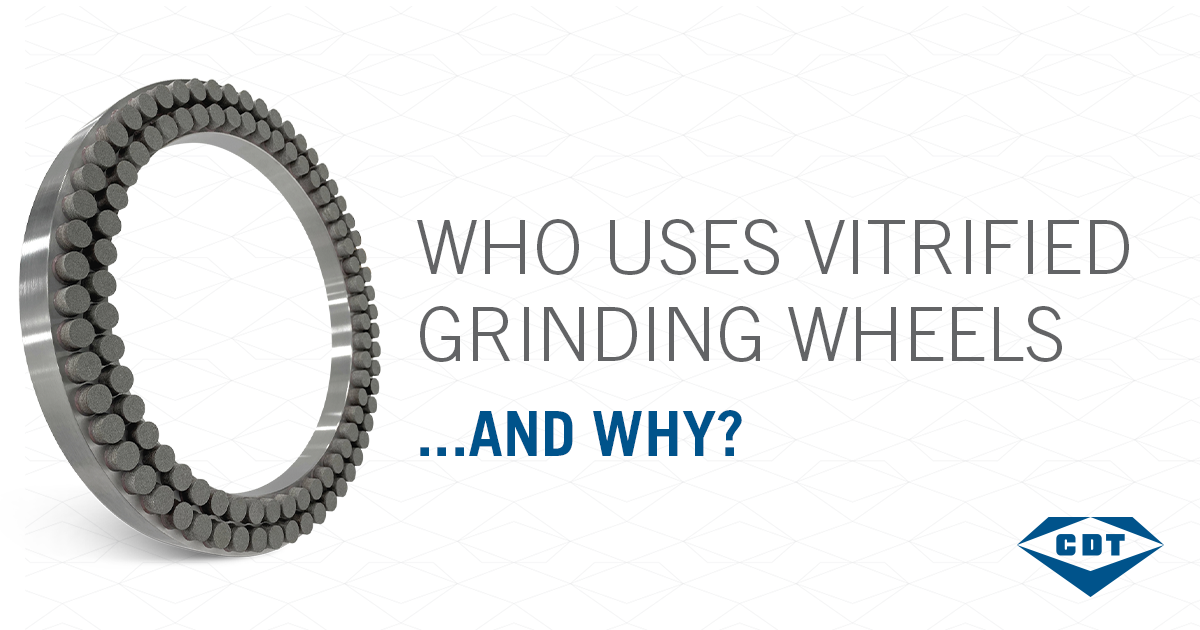
Who Uses Vitrified Grinding Wheels and Why?
At CDT, our Vitrified products generally serve two distinctly different markets, Vitrified CBN and Vitrified Diamond. Learn about what makes a Vitrified wheel and the capabilities Vitrified has.
At CDT, our Vitrified products generally serve two distinctly different markets, Vitrified CBN and Vitrified Diamond. As the two hardest known materials, CBN and Diamond are referred to as superabrasives and both are excellent thermal conductors.
These abrasive properties when combined with our porous vitrified structures allow for:
longer wheel life
shorter grinding cycle times
automated grinding production capabilities with wheels dressed right on the grinder
CBN vs. Diamond
Vitrified CBN products are ideal for steel and ferrous alloy grinding applications in automotive, aerospace, medical, production tooling, etc. They are excellent thermal conductors and do not react with ferrous materials during the grinding process like diamond does.
We regularly customize Vitrified Diamond products for grinding ceramic and carbide materials used in industries such as glass, ceramics, computer chip manufacturing, thermal spray coatings, and more. Diamond is the hardest known material with the best thermal conductivity making it the best abrasive where there is no chemical reaction.
We are uniquely qualified in both types of Vitrified products because of our full range of manufacturing capabilities and technical application support. Because we handle the vitrification process entirely onsite, we have full control of the manufacturing process and a standard lead time of about 3-4 weeks — about half as long as the industry standard.
The Vitrification Process
At CDT, we use a cold press and sintered process to press near net shape with highly and tightly controlled sintering. This fuses the Vitrified/Ceramic bond together with the Diamond or CBN into a porous structure. CDT's vitrification process is unique in how our engineers have developed a series of custom bonds, formulations, and structures to offer our customers superior grinding performance when compared with off-the-shelf or other competing products.
Combining either of these two abrasives with a porous vitrified bond offers a very strong and stiff system in which the porosity brings coolant into the grinding zone. This innovation removes heat and grinding debris (or "swarf") to extend the wheel life and improve performance. CDT's Vitrified Diamond and CBN wheels generally provide 100 to 300 times the grinding wheel life and maximize the amount of material being ground compared with conventional grinding wheels.
Reducing Cycle Times
"Cycle Time" is the term used to describe the grinding process. Our porous vitrified grinding wheels offer greater efficiency through more effective coolant delivery and swarf removal. This also extends the life of the grinding wheel requiring less downtime for wheel dressing.
When compared with conventional wheels, we see an 80-90% cycle time reduction with our custom vitrified wheels. Even compared with other superabrasives such as Resin and Metal Bond Diamond and CBN wheels, we see 40-75% reductions in cycle times with vitrified wheels.
From military/defense and energy sectors to mold & die markets and everything in between, we have found unique opportunities for more efficient grinding using custom Vitrified products in many industries. Our engineers would be happy to discuss the parameters for your process and provide a free analysis and quote for a custom grinding solution that works best for your application. Contact us today >
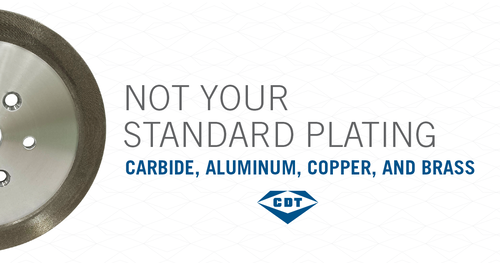
Not Your Standard Plating!
Continental Diamond Tool now offers a new generation plated product available on carbide, aluminum, copper, or steel substrate bodies.
Now available in Carbide, Aluminum, Copper, and Brass

Plating has traditionally been a single layer of abrasive with either CBN or diamond attached to a steel body. CDT now has a new generation of plated products available on carbide, aluminum, copper, or steel substrate bodies.
Carbide is a great option for mandrels and similar processes where extra rigidity is needed. Carbide provides superior hardness, unsurpassed corrosion resistance, and the ability to retain its strength at extreme temperatures.
Aluminum is light weight and easier to handle than steel, making it better for processes that require labor intensive lifting. There is less strain on your operator when working with this tool. The reduced weight also exerts less stress and wear on your machine, prolonging the life of spindles and spindle bearings. This material is also resistant to rust and corrosion and has a high strength-to-weight ratio.
Copper also offers great corrosion resistance, and it is also malleable. Its inherent flexibility allows it to maintain adhesion even if a substrate is bent and manipulated post plate. This feature makes it ideal for processes that need extra pliability.
Brass is a solution we also turn to for its malleability. It is also a good choice for dressers, because it will not cause sparking. Many grinding machines run oil-based coolant, and sparks can cause the oil to ignite. Brass is superior for these especially flammable conditions.
Steel substrate is still a highly durable option for aggressive grinding applications. The strength of the steel is long lasting and prevents damage to the core.
Each material has its advantages. When you talk to a CDT grinding specialist, they will gather information about your manufacturing goals and recommend the substrate that has the right features for your application. Stop trying to succeed with the same grinding tools your competitors are using and instead gain an advantage with grinding solutions that are specially design with your process in mind for optimal performance.
If you would like to see if your plated grinding wheels would work better with a different substrate — or to find out about innovations in vitrified, resin bond, or metal bond grinding wheels that may benefit you — contact us for a free quote: 800-443-6629.
Take a Tour of CDT’s Plating Department
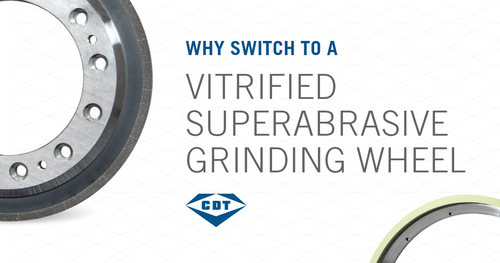
Why Switch To A Vitrified Superabrasive Grinding Wheel?
What is a Vitrified Superabrasive Grinding Wheel and what are the benefits of using one? In this blog, you’ll learn who should switch to Vitrified >
How a grinding wheel performs is dictated as much by the bond as the abrasive. Superabrasives, which can be either diamond or cubic boron nitride (CBN) have four types of bond: metal, plated, resin and vitrified. Of these, vitrified may be the least well-known, yet it’s attracting attention, thanks to the improved performance and lower costs that it offers.
WHAT IS A VITRIFIED WHEEL?
In a vitrified wheel superabrasive grit is mixed with a type of glass or ceramic and then pressed before firing in a kiln. This creates a porous, glass-like structure that holds the grit in a rigid matrix.
Unlike a plated wheel where the abrasive is just a single layer, a vitrified wheel can have considerable depth. This means the wheel can wear and go through repeated dressing. Wear rates are very low as the vitrified bonds must fracture to release worn grit and expose fresh edges. It’s also possible to put a form into the wheel to allow grinding of complex profiles, (although this does complicate dressing.)
BENEFITS OF VITRIFIED DIAMOND AND CBN WHEELS
The open, porous structure ensures the grit stands proud of the bond surface, creating a wheel that’s described as ‘free cutting.’ This means good space for chip clearance, which:
increases material removal rate
lessens dressing frequency
reduces wear
carries coolant through the grinding zone
lowers grinding forces, thus creating less heat and less work piece damage
As an additional benefit, these last five points result in lower temperatures at the interface and reduced risk of workpiece burning in metals and less microcracking in ceramic and hard materials.
Lower temperatures help maintain control over final size, as does the very rigid nature of the wheel. With minimal wheel deflection due to grinding forces and low thermal growth very high tolerances can be maintained throughout a production run.
APPLICATIONS
High volume production are ideal applications for vitrified grinding wheels. Low wear rates, combined with a free-cutting nature and ‘dressability’ mean very high material removal rates and less downtime for wheel changes.
Vitrified cubic boron nitride grinding wheels are preferred for grinding hard ferrous workpieces like crankshafts and camshafts as well as tool steels. Vitrified diamond grinding wheels are good in non-ferrous applications such as shaping ceramics and carbides.
THE HIGH-VOLUME WHEEL
Of the four main bond types, the vitrified wheel is best suited for high volume, extended production run applications. The rigid, porous structure delivers high material removal rates and extended life, helping lower manufacturing costs.
Call the engineers at CDT at 800-443-6629 to talk over your specific application and determine if a custom vitrified grinding wheel would benefit your manufacturing process.
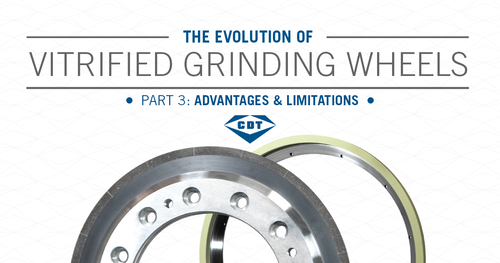
The Evolution of Vitrified Grinding Wheels (Part 3)
In part 3 of this 3-part blog series, we explore the advantages and limitations of the Vitrified Grinding Wheel in various grinding applications.
Vitrified Superabrasive wheels use either diamond or CBN in a glassy or ceramic bond. Conventional grinding wheels use either Aluminum Oxide or Silicon Carbide, as with all grinding wheels, the bond imparts certain characteristics, making it better suited to some applications than others.
ADVANTAGES
High strength structures with porosity for clearing chips and bringing coolant to grinding zone allow for reduced grinding cycle times.
Porosity for coolant and chip removal efficiently remove heat and reduce work piece thermal damage and stresses.
Efficient chip removal reduces wheel dressing frequency thus prolonging wheel life thus lowering machine down time for wheel changes and lowering waste removal costs.
High wheel stiffness, long wheel life, and minimal heat generation allow for excellent finish and dimensional tolerancing.
Wheel specifications can be optimized for each specific application (machine, coolant, work piece, stock removal, dressing, etc…)
High product uniformity and performance allows for continuous unmanned grinding operations.
Automated dressing and wheel conditioning.
LIMITATIONS
Wheel manufacturing process controls need to be tight to ensure repeatability and product consistency (most sensitive of bond systems to process variations).
Wheel designs need to be matched to the application (i.e. solid Vitrified wheels are limited to 80m/s operation, Vit wheels with steel cores can be rated for use up to 170m/s operation).
Wheel prices may seem high when compared with conventional or other Superabrasive grinding wheel prices (need to look at all costs, not just wheel price).
Significant capital investment in terms of equipment to maximize cost benefits of higher concentration CBN and Diamond Vit wheels for high volume applications.
Generally requires knowledge of complete grinding process to maximize grinding performance. Grinding application support is necessary in many applications
Difficult to cross reference competing manufacturers wheel specifications
APPROPRIATE APPLICATIONS
Vitrified CBN grinding wheels are ideal for high volume applications where productivity is paramount such as Automotive applications like Cam & Crank shaft grinding, and Aerospace engine component grinding. Recent advances in bonds and wheel specifications has led to the development of wheel structures for use on older less suitable grinding equipment and applications like surface and cylindrical grinding in mold and die shops.
Vitrified diamond grinding wheels are most suited for grinding of very hard Ceramic and Carbide materials. Applications include grinding of PCD and PCBN cutting toolings, structural ceramic components, and Carbides.
CURRENT RESEARCH
Improved bond and wheel strength through continuing work with “Ceramic” bonds.
Abrasive grit customization for better chemical and mechanical bonding in existing and new “Ceramic” bonds.
Improved understanding and modeling of the grinding process.
STILL EVOLVING
Vitrified Diamond and CBN wheels compositions continue to evolve through the use of new chemistries and processing variables to enhance grinding wheel structures and performance. When it comes to grinding hard to grind materials, there are no better abrasives than Superabrasives; Diamond and CBN. Vitrified structures combined with Superabrasives often times allows for the best compromise between wheel life and grinding performance, thus giving the lowest overall costs in grinding.
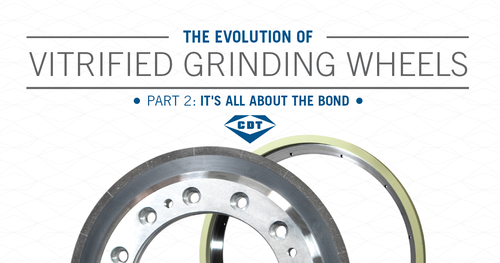
The Evolution of Vitrified Grinding Wheels (Part 2)
We reviewed the materials of the Vitrified Grinding Wheel development in part 1 of this blog series, now we will discuss the bond. Learn more >
Any review of vitrified grinding wheel development should cover both the abrasive materials and the bond medium. Part 1 of this series addressed materials; here we turn to the bond.
THE BOND MEDIUM
Grinding wheels probably originated in ancient Egypt where they were likely cut from sandstone. They also appear in sketches by Leonardo da Vinci and it's thought Belgian gem-polishers were using a cast iron wheel impregnated with diamond powder during the late 1700's, but little else is known until the early nineteenth century.
Around this time the first solid-bonded abrasive wheels appeared. These were made in India for hand-grinding gems and used emery or corundum abrasive in a gum resin shellac binder.
Rubber bond grinding wheels were introduced around 1860, again using corundum.
The first Vitrified (glass) bond wheels were commercialized about ten years later. What are today known as Resin (plastic) bonded wheels didn't appear until 1923. Metal bonds for diamond grinding wheels weren't introduced until the early 1940's.
CREATING A VITRIFIED BOND GRINDING WHEEL
The term “Vitrified" in its simplest form means “glassy” or “glass bond." Abrasive Materials such as Aluminum Oxide, Silicon Carbide, Diamond, and CBN are mixed with glass frit (ground glass) and other ceramic materials (clays, feldspars, fluxes, etc…). More recent advances in “Vitrified” bonds has led to the development of “Ceramic” bonds. In general terms, Ceramic bonds are those in which some or all of the glass phase has been converted to a crystalline phase to enhance certain material properties (i.e. higher strengths). Blended grinding wheel compositions are then formed either by “Hot Pressing” or “Cold Pressing” processes.
In Hot Pressing, the blended wheel materials are placed into a suitable mold and simultaneously pressed and sintered (baked). In sintering, the glass & ceramic components are fused and melted together forming the hard Vitrified Bond that holds the abrasive materials in place. Because the grinding wheel is simultaneously pressed and sintered at high temperatures, mold material selection has to withstand the processing temperature. Hot Pressed Vitrified wheels usually have low porosity levels and are very different in their use applications when compared with Cold Pressed Vitrified grinding wheels.
In Cold Pressed Vitrified Products, an extra material called a binder is blended into the wheel composition. The purpose of the binder is to provide handling strength to grinding wheels that are pressed in molds at room or low temperature and then removed for subsequent and separate sintering in kilns (high temperature ovens). In the sintering process, the temporary binder is removed at a low temperature and the glass is fused together at a high temperature forming the rigid hard Vitrified bond. Cold Pressed Vitrified grinding wheels generally have high levels of porosity in their structures.
Grinding wheel properties are adjusted by varying the percentage of abrasives, size of abrasives, blends of abrasives, different bonds and bond types, manufacturing process, etc… Varying the amount of the abrasive in Superabrasive Grinding wheels is referred to as the “Concentration”. Higher Concentrations contain more material and in general provide longer grinding wheel life as there are more Diamond or CBN cutting points to remove material.
CREATING POROSITY IN VITRIFIED GRINDING WHEELS
Porosity carries coolant through the grinding zone and provides space for chip clearance. By providing space to remove grinding swarf (used grinding wheel and removed work piece material), the grinding wheels are able to grind faster, provide better surface finishes (especially if the grinding fluid is filtered to remove the debris). Because open spacing in a wheel structure brings liquid coolants to the grinding zone, they are also known to grind cooler. In so doing, Vitrified Grinding wheels can remove the heat generated during grinding much more efficiently thus allowing faster grinding cycle times and less thermal damage to sensitive materials like Steels and Aerospace Alloys.
Porosity in wheels structures can be created by a variety of methods. In cold press and sinter manufacturing, the wheels are pressed to limited densities and sintering is controlled to limit shrinkage and densification. Another method for creating porosity in grinding wheel structure is through the use of additives in the wheel compositions that are then removed in the sintering stage, thus leaving voids (porosity) where the material once resided. Additional porosity can be generated by adding constituents to wheel compositions that remain within the wheel through manufacturing but are initiated when used. For example, some wheel compositions include material that doesn’t melt in processing but is dissolved in coolant upon use (i.e. Salt). Another example of induced porosity would be the use of hollow microspheres which upon use are broken open, leaving the open void as a pore.
Stay tuned for part 3 of this series where we will explore the advantages and limitations of vitrified diamond and cbn wheels in various grinding applications.
The Evolution of Vitrified Grinding Wheels (Part 1)
The vitrified bond grinding wheel first appeared 150 years ago, and continues to become ever more valuable. Learn more about the evolution >
The vitrified bond grinding wheel first appeared 150 years ago, and continues to become ever more valuable. While some products reach a kind of developmental plateau where there's no potential for further improvement, research continues to uncover ways of making vitrified wheels cut faster and last longer.
When it comes to shaping hard materials quickly, accurately, and cheaply the vitrified superabrasive grinding wheel has few rivals. Low wear, high heat stability, combined with a free-cutting nature and excellent ‘dressability’ mean very high material removal rates and less downtime.
Understanding how this tool evolved yields some fascinating insights into its use in manufacturing. This begins with an overview of grinding wheels and abrasive materials, covers the production process, and explores where the technology might be heading.
HISTORY OF GRINDING WHEELS
Any review of grinding wheel development needs to cover the two primary components: the abrasive materials and the bond medium.
ABRASIVE MATERIALS
It is thought that sandstone was the first abrasive material. Probably used for putting a sharp edge on axes, compacted quartz embedded in the rock grains proved an effective way of removing material, (much like sandpaper today.) However, as a natural material sandstone has the disadvantage that the quartz particles vary in size and shape, resulting in unpredictable performance.
An alternative material, emery, was known to the Greeks and Romans as an abrasive and is still mined on what is today the Greek island of Naxos. Emery is a form of corundum, the second hardest naturally occurring material, is the crystalline form of Aluminum Oxide containing traces of Iron, Titanium, and Chromium.
As an abrasive emery had two problems: it was expensive to extract and ship to the manufacturing centers in the UK and USA, and its performance was unpredictable due to variance in raw materials that are mined. Spotting an opportunity, entrepreneurs set about developing alternatives. The results included synthetic or manmade Silicon Carbide and synthetic Aluminum Oxide (Corundum). These materials are generally known as “Conventional Abrasives."
INTRODUCING SUPERABRASIVES
Natural Diamond, has been used for grinding since at least the seventeenth century when Belgian gem-polishers used Diamond powder embedded in cast iron. Cost and variability of natural Diamond held back wider use until the creation of synthetic Diamond changed the equation in the 1950s.
As the hardest known substance, Diamond makes an excellent abrasive in most instances. There are certain Ferrous, Cast Iron, and Aerospace alloy materials, however, that produce a chemical reaction with Diamond causing it to wear rapidly and to alter the properties of the material. To address this problem, in 1969 General Electric introduced a crystalline material they had developed with a hardness approaching that of Diamond: Cubic Boron Nitride (CBN).
Despite having a lower hardness than Diamond, CBN doesn’t react with Ferrous and Aerospace alloys when grinding and has an even higher temperature stability. Therefore, it offers better grinding performance when grinding these particularly tricky materials.
Diamond and CBN are generally known as “superabrasives" for their unique, highly effective, grinding capabilities.
In part 2 & part 3 of this series, we will look specifically at the vitrified bond medium and its advantages and limitations in various grinding applications.
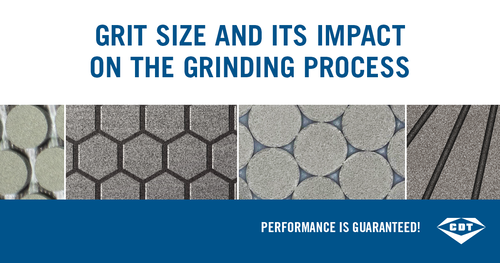
Grit Size And Its Impact On The Grinding Process
Grit size only approximately correlates to surface finish: machine condition and the type of workpiece make a big difference. Learn more >
Shop for sandpaper in the hardware store and you'll see a numbering system indicating roughness. A coarse 80 grit grade removes material quickly but leaves the surface rough while a fine 400 grit won't take much off but leaves a smooth finish.
Superabrasive grinding wheels are no different. The size or coarseness, of the grit is indicated numerically in the wheel identification code, and guides the user in how that particular wheel should be used. Diamond is available in grit sizes from 40 to 8,000 mesh while CBN comes in the range of 50 to 8,000 mesh. As with sandpaper, a smaller number signifies the abrasive particles are larger.
RELATING GRIT TO SIZE
Grit numbers are derived from mesh sizes, mesh being the standard way of grading powder. The general principle is that of sieving: the finer the mesh the smaller a particle must be to pass through the gaps between the wires. Mesh size is indicated in gaps per inch, so a mesh of 16 has 16 gaps per inch.
When referring to powders mesh size is actually shown by two numbers, such as 50/60. The first number is the sieve through which most of the powder grains would pass, and the second is the mesh size that traps most of the grains. For simplicity, in the superabrasives industry the grit number refers to the larger size mesh, the one through which most particles would pass, so powder with a mesh size of 50/60 is referred to as 50 grit.
On average, in a 50 grit powder the particles are around 300 microns or 0.011 inches in diameter. That's roughly the size of grains of beach sand, although it's important to note that sieving result s in a distribution of sizes and shapes.
IMPACT ON GRINDING PERFORMANCE
As with sandpaper, larger abrasive particles, (a smaller grit number,) remove material faster but leave a coarser finish. With a finer grit, (larger number,) each particle removes less material. The removal rate will be lower but the surface finish will be smoother.
Grit size only approximately correlates to surface finish: machine condition and the type of workpiece make a big difference. Grit size, concentration, bond type plus hardness, and the grinding process (machine, wheel speed, coolant, work-piece) all greatly impact the surface finish achieved. Our engineers take all of these factors into consideration when optimizing custom grinding tools for our clients. Contact CDT for engineered superabrasive grinding solutions.
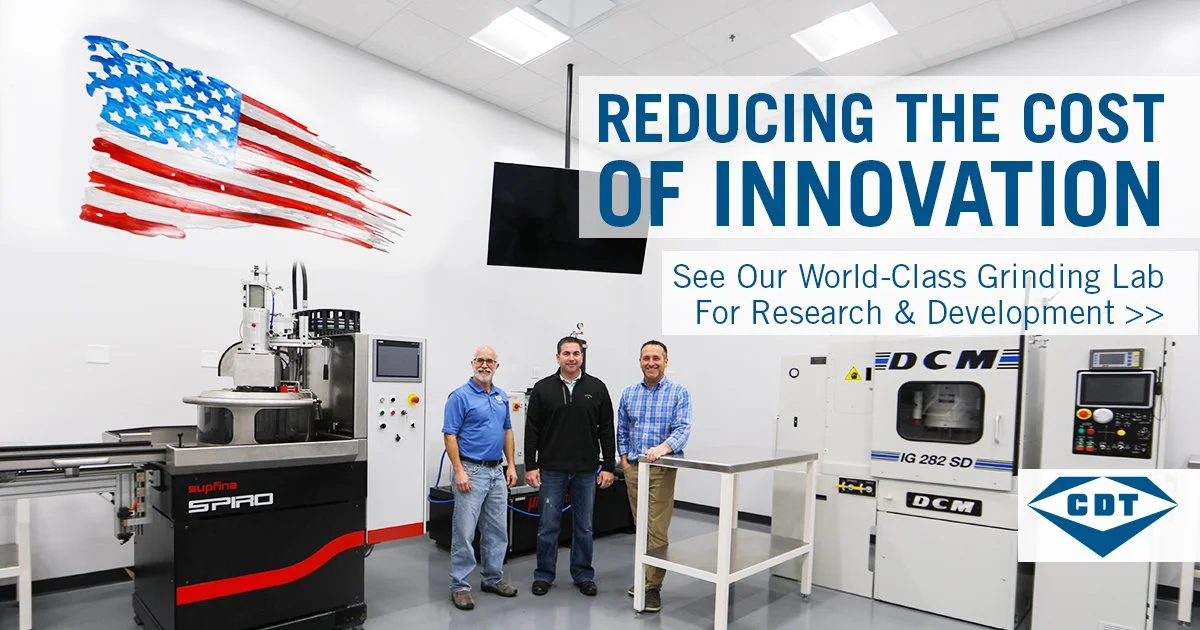
Reducing the Cost of Innovation with World-Class Grinding Lab
CDT’s grinding lab for research and development will expedite innovation in the grinding industry and reduce costs for customers.
Continental Diamond Tool is thrilled to announce its much anticipated R&D grinding lab to customers and the industry this month. The new grinding lab offers a turnkey research and development solution that will expedite innovation for CDT and its customers based on their specific industry applications.
Innovation Without the Risk
Through this research and development lab, CDT will be working to expand industry understanding of current bond technology and explore new abrasive materials. “Now our engineers can investigate their ideas extensively before ever introducing them to our customers. This takes the guess work out of innovation and eliminates the risk to our customers in pursuing new and improved technology,” says Shane Vardaman, VP of Sales at CDT.
United Grinding showcased the CDT grinding lab in their customer feature in February 2021.
Product testing in the grinding lab will provide several direct benefits to CDT customers:
Faster product development
New product trials no longer have to compete with production time.Cost-savings and reduced risk
Products can be optimized in simulations rather than expensive trials.Opportunities to innovate
We can explore a variety of product types and coolant delivery methods.Valuable data
Sensors are set up to monitor and record all aspects of the grind.Remote product testing
Customers can see and hear live trials from anywhere in the world.
Years in the Making
“The R&D grinding lab completes the final phase of our latest expansion project that was started in 2017,” says Nick Viggiano, President of CDT. “It is the culmination of a substantial effort by our engineers and many vendors to customize a laboratory environment perfectly suited to the testing of innovative grinding products that will further enhance our customers’ manufacturing productivity.”
Continental Diamond Tool celebrated the grand opening of its 130,000 sq. ft. manufacturing facility and corporate headquarters in August 2018. The R&D grinding lab, which has been in the works since the new building’s completion, occupies 925 sq. ft. of the complex. Wrapping up construction of the lab, several pieces of high-tech machinery were delivered and installed last month from well known manufacturers in the grinding industry including Ebbco, DCM Tech, Blaser Swisslube, Supfina Machine Company, and United Grinding.
Custom Capabilities
This new grinding lab is designed with ultimate flexibility and customization in mind. For example, the Walter machine from United Grinding required a few adjustments to achieve all the new testing services that CDT customers require:
“We wanted to do more than make an endmill. The high-speed workhead for cylindrical type grinding allows us increased flexibility in products we can test,” explains Jeffrey Wirth, Engineering Manager and lead on the R&D grinding lab project. "We can also explore multiple types of coolant delivery and collect other useful data from sensors that monitor all aspects of the grind. Plus, with expanded connectivity features, our engineers can run tests remotely with a secure network that allows our customers to see and hear the test in action from anywhere in the world."
With the help of United Grinding’s team, CDT has pushed the bounds of the possible in this revolutionary, world-class grinding lab. United Grinding showcased the CDT grinding lab in their customer feature this month: see video here.
With such technology behind them, CDT engineers are eager to start testing many new product possibilities. The lab is already being utilized in several customer projects. For anyone interested in taking advantage of this research and development opportunity, please call 800-443-6629 or complete our contact form to request more information.
Grinding Lab Technology
The CDT Grinding Lab includes three types of grinding machines specially outfitted with sensors that allow for the measurement and study of the grinding process. This allows CDT to simulate the grinding conditions for many applications and to develop optimal products and processes for specific materials and customers.
Why We Chose the Walter Machine for Our Grinding Lab
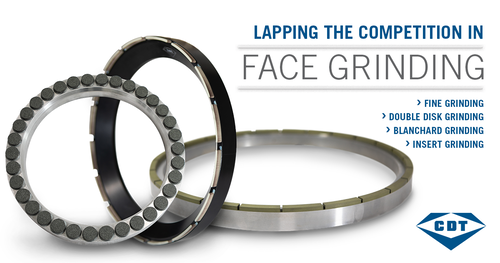
Lapping the Competition in Face Grinding
Quality and precision are essential in complex, face grinding operations. CDT has fixed abrasive grinding wheels for fine grinding, double-disk grinding, blanchard grinding and more.
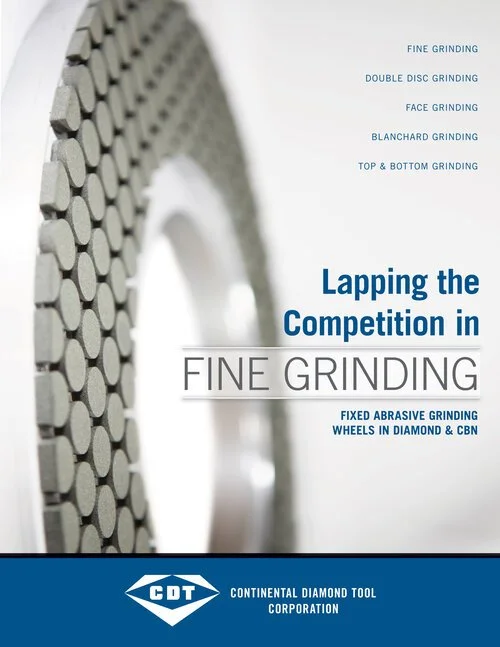
Quality and precision are essential in complex, face-grinding operations. Whether your job requires fine grinding, double disc grinding, blanchard grinding, flat honing, rotary surface, or insert grinding wheels, you need a high performance tool. The right wheel will minimize costs while providing superior results.
With a custom fixed abrasive grinding wheel, you should expect:
Decreased Cycle Times
Scrap Reduction
Increased Production
Reduced Spindle Wear
Versatility
Cycle time reduction means cost savings for your business. Your processes will be more efficient with less scrap. Your team can produce more output for the same effort. Plus, we'll work to extend the life and functionality of your tools. Often you can grind a broader range of materials with the same wheel. Download brochure.
How do we do it?
At Continental Diamond Tool, our engineers work with your manufacturing team to design, test, and build custom tools specific to your industry's process. We calculate the best grit size, bond type, and grain type to optimize the performance of your machine. The grit size of the diamond and CBN abrasive grains used in our wheels is based on the application and required surface quality. We also use grain types that differ in their characteristics (friable, blocky, free cutting, etc.) to achieve the most superior performance.
With more than 45 years experience in superabrasive manufacturing, we supply products that are compatible with all of industry's most popular machines: Stahli, Peter Wolters/Lapmaster, Viotto, Koyo, Blanchard, Gardner, Agathon, Wendt, Supfina, DCM, EWAG, Coborn, and more.
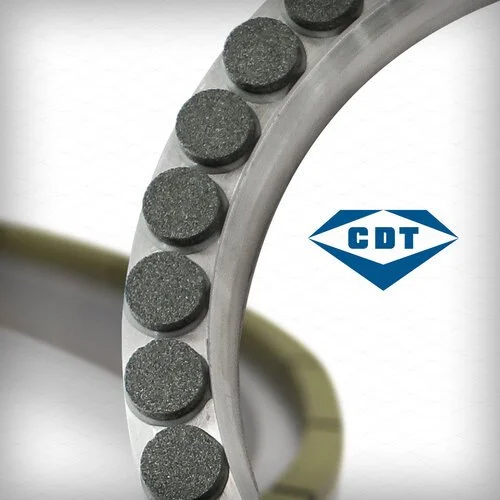
CDT's fixed abrasive wheels in diamond and CBN can be produced with grit sizes from 80 to 800. Bonds available include resin, cold-pressed vitrified, metal, and hybrid. Our state-of-the-art equipment and expertise allow us to produce some of the tightest tolerances in the industry. We also adhere to stringent quality control standards to ensure that your grinding wheels match or exceed the quality of life of your current tooling, guaranteed.
Our customer service team is available to talk through your face grinding project and provide a free quote through our website online form or call 800-443-6629.


5 Factors for Best Dressing Performance
Find the perfect rotary diamond dresser for your application by considering these 5 factors. Continental Diamond Tool Limited offers decades of expertise and free consultations for customized solutions >
The intricacies of selecting the ideal rotary diamond dresser for your unique application depend on many factors like tolerance, surface finish, configuration of form, grinding machine type, and grinding wheel specification. Continental Diamond Tool (CDT) has extensive experience in designing and crafting dressing solutions that perfectly suits your needs. Customization is key. Read on to discover how tailoring a diamond rotary dresser to your process can improve grinding performance.
Plunge dressing vs. Traverse dressing
Traverse dressing and plunge dressing are two methods that employ diamond rotary dressers in precision grinding applications. Each dressing technique requires a different form to serve its unique purpose.
Traverse dressers are designed to move across the surface of a grinding wheel, gradually shaping and refreshing its profile to maintain consistent performance and geometric precision. This method is ideal for applications where maintaining a constant wheel profile is crucial, such as in high-precision cylindrical grinding.
On the other hand, plunge diamond rotary dressers are employed to create specific, intricate profiles or contours in a grinding wheel. By plunging the dresser directly into the wheel, they generate complex shapes and features with precision. These dressers are particularly valuable in applications requiring customized workpiece forms, like gear grinding or aerospace components.
Both methods play a vital role in the manufacturing industry, ensuring the optimal condition and shape of grinding wheels. This, in turn, guarantees the quality and accuracy of the finished workpieces.
DIAMOND ROTARY DRESSER TYPEs
The diamonds in Diamond Rotary Dressers are what give this technology its cutting edge. There are four unique processes that can be used to adhere the diamonds to the dresser form:
REVERSE PLATED - Reverse Plated Dressers are best suited for applications where high accuracy of profile and a correspondingly high quality surface finish on the component are required.
HANDSET SINTERED - Handset Sintered Dressers are our most commonly used type of Rotary Diamond Dresser. They cover applications where robustness is required and the general tolerance is open.
CVD SINTERED - CVD Sintered Dressers are highly resistant to chipping and fracture, and they wear evenly over the dresser’s entire length. They also have outstanding thermal stability in use.
RANDOM SET SINTERED - Random Set Sintered Dressers are perfect for applications requiring openness, tight form, and improved surface finish. They can be delivered quickly to meet urgent demand.
Sometimes called Truers or Rollers, how do you know which of these will be the best diamond rotary dresser type for your application? Especially when each of these categories contain many further variables of appropriate diamonds and setting patterns.
5 factors for proper dresser selection
Proper dresser selection starts with investigating these five factors. Every well designed dressing tool must meet the specific requirements of these areas:
TOLERANCE - Tolerance refers to the allowable deviation or variation from a specified measurement or dimension in a workpiece. In the context of dressing tools, it's essential to consider the level of precision or accuracy required in the dressing process to meet the desired workpiece tolerances.
SURFACE FINISH - Surface finish pertains to the quality and texture of a workpiece's surface after the grinding or machining process. When designing a dressing tool, you need to account for the desired surface finish, which can range from rough to smooth, as it influences the choice of abrasive grains and dressing techniques.
CONFIGURATION OF FORM - Configuration of form relates to the specific shape, contour, or profile that the dressed grinding wheel should have. It encompasses the design and geometry of the wheel, which needs to be precisely replicated by the dressing tool to achieve the desired workpiece shape or finish.
GRINDING MACHINE TYPE - The type of grinding machine used in a particular application, such as cylindrical, surface, or centerless grinding, significantly impacts the dressing tool's design. Different machines require specific dressing techniques and tools to optimize performance and precision.
GRINDING WHEEL SPECIFICATION - This factor involves the characteristics and properties of the grinding wheel to be dressed. It encompasses details like wheel diameter, abrasive type, grain size, bonding material, and other specifications. The dressing tool must be compatible with these wheel specifications to ensure effective and efficient dressing.
Considering these factors when designing a dressing tool is crucial to achieving the desired precision, surface finish, and workpiece quality in various grinding applications. Correct specification involves the appropriate design, selection and placement of diamonds in a way that takes into account all the factors affecting the individual customer's application. It cannot be achieved by choosing from a small range of general purpose dresser types. Customization is required.
Our team at CDT has decades of experience in specifying and manufacturing Rotary Diamond Dressers for individual applications is second to none. Our processes are what make the Consort Precision™ Diamond Rotary Dresser truly exceptional, winning awards in the industry. We now manufacture and ship our custom diamond rotary dressers from both Europe and North America. The best part? It you costs nothing to consult with us—so contact us first to find the very best fit for your project.

Custom Rotary Diamond Dressers in as little as 4 weeks: How do we do it?
Industry-standard lead times for diamond rolls can take 8 weeks or more. If you are looking for a better, faster rotary diamond dresser alternative, we can expedite service in as little as 4 weeks. Learn how >
Since 1984, Consort Precision Diamond has supplied diamond wheel dressing products to a broad range of industries including aerospace, aircraft, automotive, blade and knife, power generation, medical, cutting tools, tool & die, saw, gear, and bearing and many other applications. What all these grinding operations have in common is that they typically require some form of wheel dressing to re-establish the wheel profile and/or recondition the wheel face.
About Wheel Dressing or Conditioning
Wheel conditioning involves the sharpening and opening of the wheel face, while also removing dull abrasives, excessive bond, and workpiece material (loading). A sharp and open wheel face will allow maximum possible material-removal rates and reduced thermal stress on the workpiece.
Consort’s rotary dressers provide the ideal profile for your desired wheel topography, with superior materials and manufacturing technology. Because your dresser is custom manufactured, demanding and complex configurations are possible.
Diamond Roll Delivery in as Little as 4 Weeks
The question then turns to delivery and lead times. In business, time is money. Industry-standard lead times for custom rotary diamond dressers can take 8 weeks or more. That’s a long time to wait for a critical part in your manufacturing process. Consort has made a reputation for fast delivery with a standard lead time of 6-8 weeks.
Need a tool in a hurry? Customers can request “Expedited Service” for custom diamond roll delivery in as little as 4 weeks. With manufacturing, delaying maintenance can really add to your costs in the long run. When a job is expedited, we work with our customers to get them their tooling as soon as possible.
We pride ourselves on prompt service and communication. At any time, you can reach out to your Consort account representative to begin an order or find out its status. If you do not have an account rep, please reach out to our customer service through our website online form or call 800-443-6629.
Lead times should not be a hurdle in the proper maintenance of your grinding equipment. If you are looking for a better, faster diamond roll supplier, let our service techs help you get the process started.


